How to Work Safely on a Car in Extreme Summer Heat
I’ll help you decide when and how to work on a car safely during extreme summer heat, from handling hot metal and pressurized coolant to managing fuel vapors, ventilation, heat illness, and the point where stopping is the smart repair choice.
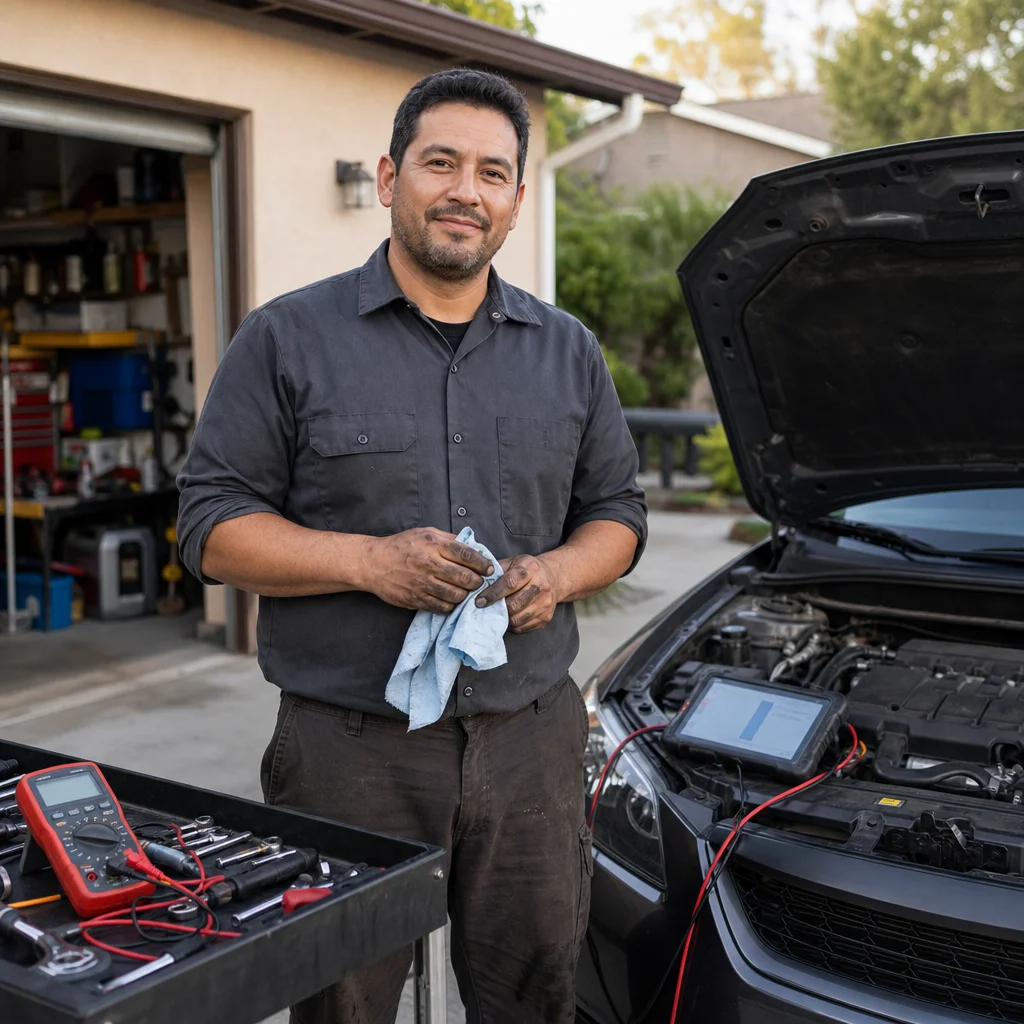
Extreme heat changes an ordinary repair into a higher-risk job. Metal can remain hot long after the engine is switched off, coolant systems can stay pressurized, and heat illness can develop before you realize how impaired you are. A repair that is manageable on a mild morning may be a poor choice in direct summer sun.
The safest approach is to treat heat as part of the repair diagnosis. Plan around the weather, prepare a way to leave the job safely, and recognize that stopping is sometimes the correct recovery step rather than a failure to finish.
Check today’s conditions first
Before you begin, review the current heat advisory, air-quality conditions, and weather forecast for your location. Follow the vehicle manufacturer’s repair and cooling-system instructions, and move the job to a cooler part of the day if conditions are severe.
Choose the right time, place, and stopping point
Early morning is usually safer than the afternoon, but don't assume the vehicle is cool simply because the air feels cooler. A car parked in the sun can retain heat in its engine bay, exhaust components, brake parts, and body panels. Shade helps, although it doesn't instantly cool the vehicle. A solid roof or shaded work area is better than a temporary umbrella, but it still needs good airflow.
Work on a firm, level surface away from traffic. Set the parking brake, place the transmission in Park or in gear as appropriate, and use wheel chocks when the vehicle is raised or when the surface isn't perfectly level. Keep your phone, vehicle keys, water, and a charged light within reach. If you become dizzy or need to leave quickly, you shouldn't have to search for basic items or crawl under the car to retrieve them.
Plan the job in stages. For example, you might inspect and gather tools in the heat, then wait for the engine to cool before opening the cooling system. If a task requires lying under the vehicle, schedule it for the coolest practical period and avoid starting when you already feel fatigued.
A sensible stopping point is any moment when concentration, grip, or balance is declining. It is also time to stop if a fastener is becoming rounded, a jack is shifting, a hose is unexpectedly damaged, or you can't clearly identify a fluid or component. Heat makes rushed decisions more likely, and a small mistake can turn a routine repair into a burn, fire, or vehicle-support accident.
Protect yourself from heat illness
Wear lightweight clothing that still protects your skin from sharp edges and hot components. Safety glasses are useful whenever you are under the vehicle or working around pressurized fluids. Use gloves that provide dexterity and some heat protection, but remember that gloves can also trap heat and reduce your awareness of how hot a surface is.
Drink water regularly rather than waiting until you feel very thirsty. Take breaks in a genuinely cooler area, not just on the other side of the vehicle. A fan can improve comfort in a shaded, ventilated space, but it doesn't replace rest, hydration, or leaving the area when symptoms begin. Avoid using alcohol before or during the job, and be cautious with anything that can contribute to dehydration or drowsiness.
Heat exhaustion can involve heavy sweating, weakness, headache, nausea, dizziness, or unusual fatigue. Stop working, move to a cooler place, loosen unnecessary clothing, and drink fluids if the person is alert and able to swallow. Confusion, fainting, seizures, loss of consciousness, or very hot skin should be treated as an emergency. Call emergency services and follow their instructions rather than trying to finish the repair or drive the person somewhere yourself.
Don't work alone on a difficult or high-risk repair in severe heat. Tell someone where you are, how long the job should take, and what to do if you stop responding. A second person can notice changes in your condition that you may dismiss while focused on the car.
Treat hot metal and exhaust parts as burn hazards
The temperature gauge only tells you about the coolant temperature, not the temperature of every part in the engine bay. Exhaust manifolds, turbochargers, catalytic converters, brake components, pulleys, belts, and some hoses can remain dangerously hot after the gauge appears normal. Direct sunlight can also make painted panels, tools, and exposed fasteners hot enough to hurt you.
Keep your hands clear until you have deliberately confirmed that a component is safe to touch. Don't test a hot part with bare skin. Use a visual inspection, a suitable noncontact thermometer if you have one, or the manufacturer’s cooling-time guidance. A thermometer can help, but it doesn't make it safe to work around moving belts, fans, or energized components.
Electric cooling fans deserve particular caution. Some vehicles can switch the fan on unexpectedly, including after the ignition is turned off, depending on the vehicle’s design and operating conditions. Keep hands, clothing, tools, and hair away from fans whenever the battery is connected and the fan circuit could be active. If the repair requires disabling power, follow the service information for that vehicle rather than disconnecting components at random.
Never treat a hot cooling system as ready to open
A cooling system can remain pressurized after the engine is shut off. Removing a radiator cap, expansion-tank cap, or similar pressure cap while the system is hot can release scalding coolant and steam. The fact that the engine has stopped, the hood is open, or the gauge has moved down doesn't by itself prove that pressure is gone.
If the vehicle has overheated, switch it off in a safe location and allow it to cool fully. Don't pour cold water over a hot engine to speed the process; sudden temperature changes can damage components, and you can create more steam or a slipping hazard. Keep people away from the front of the vehicle while it cools, especially if coolant is leaking.
Only inspect the pressure cap and coolant level according to the vehicle’s instructions and after the system is cool enough to do so safely. Some vehicles use a pressurized expansion tank rather than a conventional radiator cap. Read the markings and warnings on the reservoir or cap, and don't assume that every plastic tank is safe to open while warm.
If coolant is low, look for the reason rather than treating the level as the entire repair. A visible leak, damaged hose, failed water pump, stuck thermostat, blocked radiator, cooling-fan problem, or combustion-gas leak can all produce overheating. Don't crawl under a hot vehicle to search for a leak, and don't place your face over the engine bay while checking for steam or spray.
Control fuel vapors and ignition sources
Summer heat increases the volatility of gasoline, so fuel vapors can collect quickly around an open fuel system. Work outdoors or in a properly designed, well-ventilated work area. Don't work on fuel lines, the fuel tank, or an open filler neck in an enclosed garage with an ignition source nearby.
Keep cigarettes, grills, pilot lights, heaters, hot work, and sparks away from the vehicle. Avoid switching electrical equipment unnecessarily near a fuel spill, and don't use a shop vacuum unless it is specifically suitable for the material and situation. A hot exhaust component or electrical fault can ignite vapors even when you aren't using a torch or grinder.
If fuel spills, stop the repair and remove ignition sources if you can do so safely. Allow vapors to disperse, absorb the liquid with an appropriate material, and dispose of contaminated materials according to local requirements. Never start the vehicle to move it through a fuel spill. A strong fuel smell, wet fuel line, damaged tank, or leak that continues after the repair attempt is a good reason to stop and arrange professional help.
Ventilation matters for more than fuel. Never run an engine in a garage, carport with poor airflow, or other enclosed area. Carbon monoxide is colorless and odorless, and opening a door may not provide enough protection. If the engine must run for a diagnostic test, move the vehicle outdoors with the exhaust directed away from people and buildings, and keep the test as short as possible.
Use safer lifting and tool practices in hot conditions
Heat can make gloves sweaty, tools harder to hold, and the ground softer or less stable than it appears. Before lifting the vehicle, inspect the jack, stands, and lifting points. Use the manufacturer’s recommended points and place jack stands on a firm surface. Never rely on a hydraulic jack alone to support a vehicle while you work underneath it.
Position tools so you can reach them without stretching across hot components or walking around the vehicle repeatedly. Keep loose clothing, towels, and extension cords away from belts and fans. A shaded tool tray or insulated surface can help prevent burns from tools left on the vehicle, but check tools before picking them up.
Avoid spraying flammable cleaners or penetrants onto hot exhaust parts. Let components cool, follow the product label, and provide ventilation. Don't substitute a torch for patience when nearby fuel, wiring, plastic parts, or pressurized fluids may be involved.
If the car overheats during or after the repair
If the temperature warning appears, the gauge enters the hot range, steam escapes, or the vehicle gives a clear overheating warning, stop treating it as a normal test drive. Pull over somewhere safe as soon as possible, switch off the engine, and keep clear of steam, coolant, traffic, and moving fans. If you are on a busy road or in an unsafe location, prioritize getting professional roadside assistance rather than opening the hood beside traffic.
Once the vehicle is fully cool, you can perform a visual check for an obvious hose failure, a detached electrical connector, a broken belt, or a large coolant leak. Don't restart the engine simply to see whether the problem has disappeared. If coolant is leaking heavily, the belt has failed, the engine oil looks contaminated, or the cause isn't obvious, arrange a tow or professional diagnosis.
Adding coolant may be appropriate only when the system is cool, the correct fluid is available, and the vehicle’s instructions allow it. Water may be an emergency short-term measure in some situations, but it isn't a universal substitute for the specified coolant mixture, and adding any liquid won't fix a leak or failed cooling component. Record what happened and what you added so the next diagnosis is more accurate.
Know when professional help is the safer repair
Stop and seek help when the job involves a pressurized fuel system, a fuel-tank removal, a suspected refrigerant release, high-voltage hybrid or electric-vehicle components, extensive underbody access, or a vehicle that can't be supported securely. Extreme heat is also a reason to hand off a repair that would normally be within your ability if you are alone, dehydrated, short on time, or unable to work in shade.
A professional diagnosis is especially sensible after repeated overheating, an unexplained coolant loss, an engine that won't restart after overheating, or any sign of fire or electrical damage. Continuing to replace parts without identifying the cause can increase both repair costs and safety risks.
The safest summer repair is one that leaves you with control over the environment, the vehicle, and your own condition. Work during the coolest practical hours, let hot and pressurized systems cool completely, control ignition sources and fumes, and use proper vehicle support. If heat, uncertainty, or a worsening fault removes that control, pause the job and arrange a safer recovery plan.