When Is It Safe to Work Under a Car at Home?
When a repair requires access beneath a vehicle, the surface, lifting method, and task can change the risk quickly. I’ll help you assess those factors and recognize when a professional setup is the safer choice.
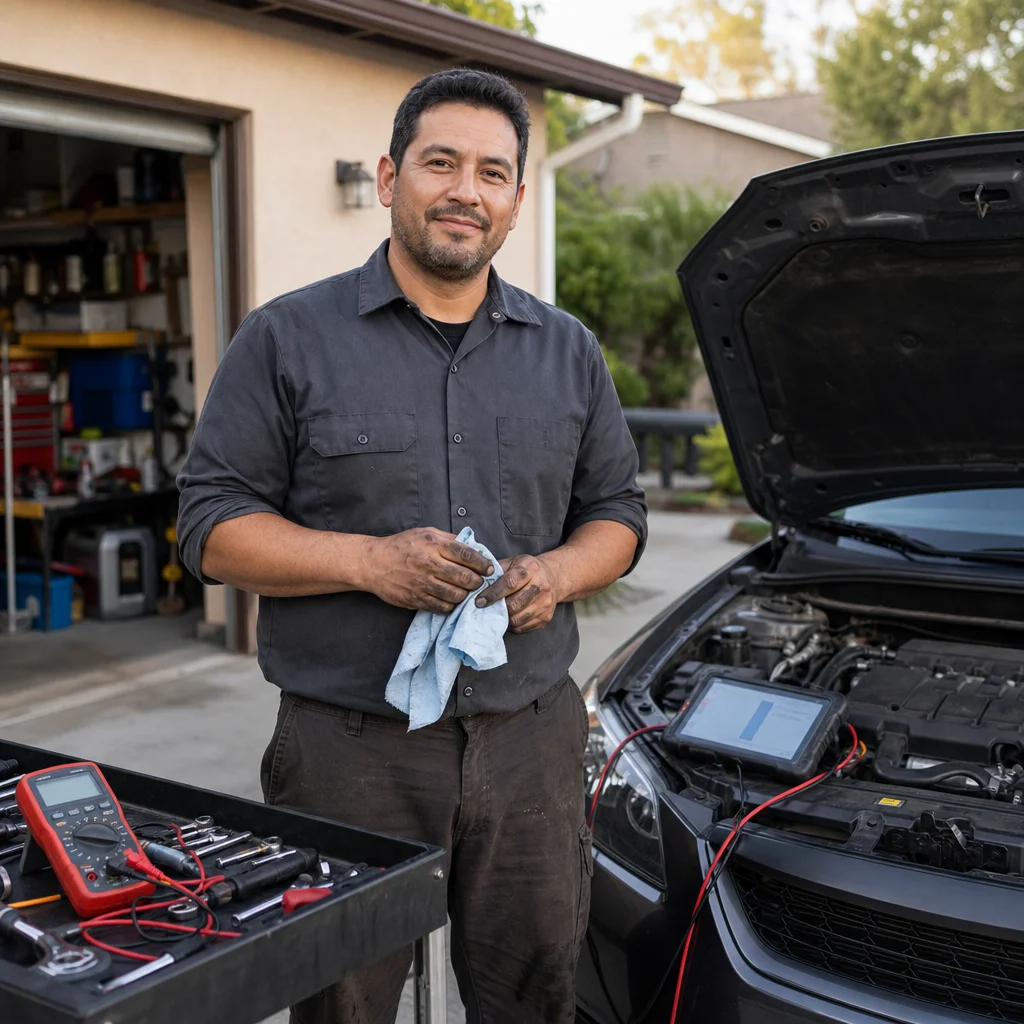
Working under a car at home is sometimes reasonable, but the decision depends on more than whether the vehicle is parked in your driveway. You need stable ground, correctly rated lifting equipment, reliable support, and a task that won’t disturb the vehicle’s balance. If any one of those conditions is uncertain, the risk can rise sharply.
The safest approach is to assess the entire setup before lifting anything. A strong floor doesn't make an unsuitable jack safe, and a quality jack doesn't compensate for a sloping or soft surface. Your goal isn't merely to raise the vehicle; it is to keep it stable while you work, including when you apply force to a seized fastener or shift your position underneath it.
Start with the ground and surroundings
A level, solid concrete floor is the best home-work surface. It allows a floor jack and jack stands to remain properly aligned and gives the stand bases a firm platform. A clean, dry garage floor is preferable because oil, water, ice, and loose debris can reduce footing and make equipment harder to position accurately.
A paved driveway may be suitable if it is genuinely level and in good condition. Check for a noticeable slope, cracks, soft patches, and edges where a jack wheel or stand foot could settle unevenly. Asphalt can soften in hot weather, while gravel, dirt, grass, pavers, and compacted soil can shift under concentrated loads. A scrap of wood or a thin board isn't a dependable substitute for a properly solid work surface unless the equipment manufacturer specifically permits that arrangement.
Leave enough room to approach the vehicle from outside as well as underneath. You may need to move the jack, retrieve a tool, or exit quickly. Keep doors, ramps, creepers, and electrical cords from creating trip hazards. Don't work beneath a vehicle in conditions where rain, wind, snow, poor lighting, or freezing temperatures make the surface or equipment difficult to control.
Confirm your setup: Before lifting, check the vehicle owner’s manual and the lifting-equipment instructions for approved lift points, weight limits, placement requirements, and any conditions that would make your surface unsuitable.
Use lifting equipment for support, not just access
A jack is designed to lift a vehicle, not to hold it while you work beneath it. Hydraulic seals can leak, a jack can roll or tip, and an incorrectly positioned saddle can slip from a lifting point. For that reason, never put any part of your body under a vehicle supported only by a floor jack, trolley jack, bottle jack, or the vehicle’s emergency scissor jack.
Once lifted, the vehicle should rest on jack stands placed at approved support points. Use a pair or other arrangement appropriate for the vehicle and the job, and make sure the stands have enough capacity for the load they may carry. The rating should be legible and the stands should be undamaged, stable, and fully engaged according to their design. Don't improvise with stacked wood, concrete blocks, furniture, buckets, or other objects that weren't made for vehicle support.
Position stands on the same solid, level surface as the jack. Set the stand height before placing it under the vehicle when possible, then lower the vehicle slowly so the load settles onto the stands. Keep the jack available as a secondary positioning aid only if it doesn't interfere with the work; it mustn't be treated as a replacement for properly placed stands.
After supporting the vehicle, give it a controlled stability check from outside the danger area. A careful push at a solid part of the body can reveal obvious rocking or settling, but don't shake the vehicle aggressively and don't crawl underneath to inspect it. If the vehicle moves, lower it and correct the setup before proceeding.
Chock the wheels that remain on the ground, following the vehicle and equipment instructions. Set the parking brake when appropriate, select Park for an automatic transmission, or select a suitable gear for a manual transmission. These measures help prevent rolling, but they don't make an unstable lift safe and should never be used to justify working under an improperly supported vehicle.
Consider what the repair will do to the vehicle
The task itself affects whether the setup is safe. Jobs such as inspecting a leak or changing engine oil may involve limited force, but even these require enough clearance and secure support. Removing a wheel, brake caliper, suspension component, exhaust section, driveshaft, fuel tank, or heavy underbody shield can change the vehicle’s weight distribution or allow a component to move unexpectedly.
Be especially cautious with repairs that require pulling, striking, prying, turning a stubborn fastener, or using a long breaker bar. Your force can push the vehicle sideways or pull it off a poorly positioned stand. If the work requires a transmission jack, engine support fixture, spring compressor, press, or other specialized equipment, the risk is no longer limited to simply raising the vehicle. The equipment and procedure need to be designed for that specific load.
Suspension work has another complication: the suspension may need to be loaded or unloaded for the repair. A vehicle supported by the body can allow suspension components to hang, while a control arm or axle may need separate support to prevent sudden movement. Never place a jack beneath a component unless the repair procedure identifies it as a suitable support or lifting point.
Wheel ramps can be useful for some tasks, particularly when both drive wheels need to remain on the ground. They must match the tire size and vehicle weight, sit squarely on a suitable surface, and be driven onto slowly. Ramps don't provide safe access to every part of the underside, and a vehicle should never be partly on ramps and partly on improvised supports. Follow the ramp manufacturer’s instructions and keep the wheels secured as directed.
Account for vehicle-specific hazards
The owner’s manual and a reliable service procedure matter because lifting points vary. Unibody vehicles may have thin floor sections, pinch welds, battery enclosures, plastic trim, or other areas that look strong but aren't intended to carry the vehicle. A jack or stand placed on the wrong point can bend the body or slip without warning.
Electric and hybrid vehicles introduce additional reasons to stop and identify the repair correctly. High-voltage cables and components may be marked with distinctive insulation or warning labels, but you shouldn't rely on appearance alone. Work involving the traction battery, orange high-voltage wiring, electric drive unit, or damaged battery case may require manufacturer-specific training and isolation procedures. A conventional oil-change or tire-related task may still be possible, but avoid touching unfamiliar components beneath the vehicle.
Air suspension, self-leveling systems, active suspension, and vehicles with automatic ride-height controls can move after you switch off the engine. The service procedure may require a special mode or a particular support method. Air springs and pressurized systems can also release energy suddenly if damaged or disconnected. If you can't identify how the system should be disabled and supported, leave the work to a qualified technician.
A recently driven vehicle can also create hazards. Exhaust parts, catalytic converters, engine oil, coolant, transmission fluid, and brake components may remain hot. Let the vehicle cool when the repair allows, and use eye protection when dirt or fluid could fall. Don't run the engine in an enclosed garage, even with the door open; carbon monoxide can build up quickly and isn't reliably detectable by smell.
Know when home work is the wrong choice
Professional help is the sensible option when you lack a level surface, suitable stands, or a way to verify the vehicle’s support points. It is also the right choice when the vehicle is badly damaged, has been in a collision, is sinking into the ground, or can't be lifted evenly. A roadside jack and the emergency equipment supplied with a vehicle are intended for limited situations, not for extended repairs beneath the vehicle.
Stop if a stand won't sit flat, the jack saddle slips, the vehicle rocks, the support point deforms, or you hear cracking, popping, or hydraulic leakage. Lower the vehicle only if you can do so without placing yourself in the danger area; otherwise, move away and arrange professional assistance. Don't try to catch, steady, or reposition a vehicle that is already shifting.
Choose a professional for repairs involving fuel-system damage, high-voltage components, compressed springs, structural damage, major drivetrain removal, or a heavy component that must be supported independently. Lack of experience isn't itself a failure. The important question is whether you can identify every load, movement, and energy source involved in the job and control it with the correct equipment.
Make the final decision before you lift
Working under a car at home can be acceptable when the surface is firm and level, the equipment is correctly rated and positioned, the vehicle is secured against movement, and the repair doesn't introduce forces or hazards you can't control. These conditions should all be true together. If one depends on a guess—such as the strength of the ground, the correct lift point, or the stability of a homemade support—don't proceed underneath the vehicle.
Before starting, read the vehicle-specific lifting information, inspect the jack and stands, clear the work area, and plan how the vehicle will be lowered. Use eye protection and keep your body out of the space beneath the vehicle while lifting and lowering. If the job requires specialized support, exposes high-voltage or pressurized systems, or leaves you uncertain about stability, paying a professional is usually a better trade-off than trying to make an unsafe setup work.