When Should You Stop a DIY Repair and Call a Mechanic?
A DIY repair can change from manageable to risky when diagnosis, tools, or consequences become uncertain. I’ll explain how to weigh safety, confidence, seized parts, and repair complexity before deciding whether to continue or call a mechanic.
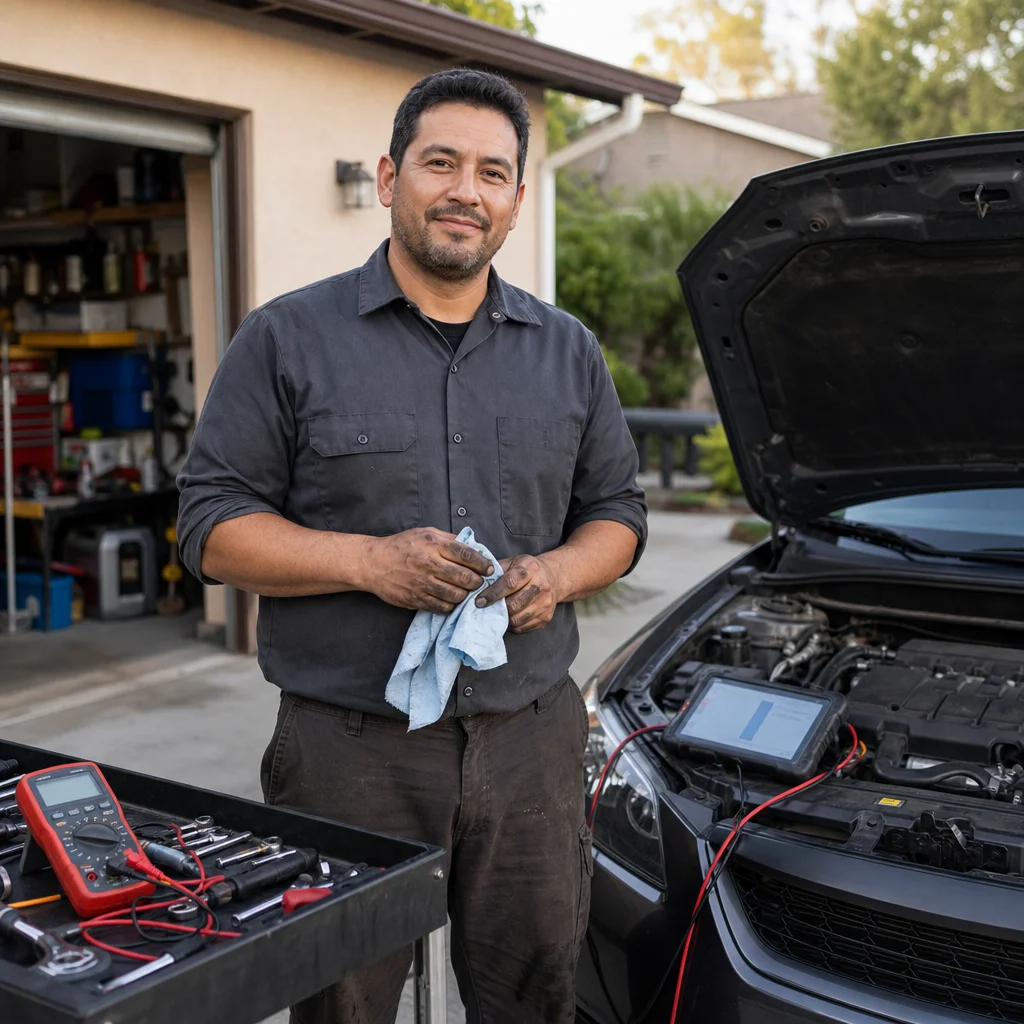
DIY repair usually becomes a problem before the vehicle actually stops you. The warning signs may be less dramatic: you’re no longer sure which part has failed, the repair needs a tool you don’t have, or one mistake could affect steering, braking, fuel, or the engine’s timing. Recognizing that point is part of repairing a car responsibly.
Stopping isn’t the same as giving up. It means protecting yourself, the vehicle, and your repair budget while the problem is still contained. A useful decision comes down to five questions: Is the work safe to perform? Do you have a reliable diagnosis? Do you have the right tools and information? Can you recover if a fastener or component is damaged? What happens if the repair is done incorrectly?
Start with the consequences of being wrong
Not every repair deserves the same level of caution. Replacing a cabin air filter and replacing a brake caliper may both involve removing parts, but the consequences of an error are very different. A mistake with a filter may reduce airflow. A mistake with a brake system can reduce stopping ability.
Before continuing, identify what the repair controls. Work involving steering, braking, suspension attachment points, fuel leaks, high-voltage systems, or engine timing deserves a lower tolerance for uncertainty. The same is true of repairs where a loose fastener, damaged seal, or incorrectly routed line could create a hazard after you leave the driveway.
You should also consider whether the vehicle can be safely moved if the repair remains incomplete. If it is supported only by a jack, leaking a hazardous fluid, or partly disassembled around a safety-critical system, don’t treat “I’ll just put it back together” as an easy fallback. Secure the vehicle and arrange professional help or appropriate transport instead.
Confirm the safety-critical procedure: Before working on brakes, steering, suspension, airbags, fuel systems, or high-voltage components, check the vehicle’s service information and the tool and support requirements for that exact model. If you can’t verify the procedure safely, stop and arrange professional service.
Stop when the diagnosis is only a guess
A repair is much easier to judge when you know what failed and why. A diagnostic trouble code, warning light, noise, or visible leak can identify a system without identifying the faulty part. Replacing the most obvious component may solve the problem, but it may also waste money and add a new fault.
For example, a code related to an oxygen sensor circuit doesn’t automatically prove that the sensor itself needs replacement. The problem could involve wiring, a connector, a fuse, an exhaust leak, or another condition affecting the reading. Likewise, a battery warning light may point toward a charging-system problem, but it doesn’t tell you whether the cause is the battery, alternator, belt, cable, or connection.
You’re approaching the stop point when your plan sounds like, “I’ll replace this and see what happens,” but you have no follow-up test. That approach is especially risky when the part is expensive, difficult to access, or capable of causing additional damage if it isn’t the cause.
Before buying a replacement part, ask yourself what evidence supports the diagnosis and what result would confirm or reject it. If you can’t answer those questions, pause. A mechanic may be able to test the circuit or component more quickly than you can continue replacing parts by elimination.
Treat missing tools as a real limit
Some repairs are straightforward only when you have the equipment to do them correctly. A basic socket set may be enough for routine maintenance, but other jobs can require a torque wrench, scan tool with special functions, electrical test equipment, a pressure bleeder, a spring compressor, a puller, or a way to support a heavy component.
Improvising with the wrong tool can turn a manageable repair into a damaged fastener, crushed component, electrical short, or personal injury. A tool borrowed from a parts store or friend may be useful, but confirm that it is suitable for the job and that you know how to use it. A generic code reader, for instance, may display a fault code without performing the manufacturer-specific tests or relearn procedures needed afterward.
Special tools don’t automatically mean you must call a mechanic. Renting the correct tool and following reliable instructions may be reasonable for a repair you understand. The important distinction is whether the tool solves a known requirement or merely encourages you to proceed without understanding one.
If the repair depends on equipment you can’t obtain, or on measurements you can’t make accurately, stop before disassembly. Paying for a focused professional procedure is often cheaper than repairing damage caused by guessing.
Know when a seized part has changed the job
Rust, corrosion, heat, and age can turn a simple repair into a much more involved one. A fastener that refuses to move may need penetrating lubricant, controlled heat, a different socket, an extractor, or replacement hardware. A pressed-in bearing, damaged sensor, rounded bolt, or stuck brake component may require equipment and experience beyond the original task.
Stop if the fastener begins to round, the tool is slipping, the part is bending, or you’re applying force without knowing what will break first. More leverage isn’t always more progress. You can snap a bolt inside an engine or suspension component, break a casting, strip a delicate fitting, or damage a brake line while trying to save a few minutes.
A seized part also changes the time and cost estimate. You may need to remove surrounding components, drill out hardware, replace brackets, repair threads, or obtain new fasteners. If the vehicle is your only transportation, consider whether leaving it disassembled is practical. Taking a pause while everything is still identifiable is usually better than escalating the damage.
Consider the consequence of an incomplete repair
Some jobs can safely wait with the vehicle parked. Others become dangerous if the repair is interrupted. Before starting, think through the worst realistic outcome if you run out of time, discover another problem, or can’t reinstall a component.
This matters when opening a cooling system, disconnecting fuel lines, removing suspension components, working beneath the vehicle, or disturbing electrical and restraint-system wiring. It also matters for repairs that require a post-repair adjustment, bleeding procedure, calibration, or test drive. If you can’t complete that final step, the vehicle may not be ready to drive even if it starts.
A sensible DIY repair has a stopping plan. Keep removed parts organized, take photographs before disconnecting unfamiliar wiring, protect openings from dirt, and avoid starting a job immediately before you need the vehicle. If the work becomes unsafe, leave the vehicle secured rather than rushing to make it usable.
Use a simple stop-or-continue decision
Continue when you have a clear diagnosis, the correct information and tools, a safe work area, and a repair whose consequences you understand. You should also have a way to verify the result, such as checking for leaks, confirming correct operation, clearing and rechecking a fault, or completing the required adjustment.
Stop and call a mechanic when one or more of those conditions is missing—particularly when the missing piece involves personal safety or a safety-critical system. A professional is also the better choice when the repair requires specialized calibration, programming, internal transmission or engine work, air-conditioning refrigerant service, or high-voltage battery procedures that you aren’t equipped and trained to perform.
You don’t have to choose between doing everything yourself and handing over the entire vehicle. You can perform the safe, well-understood portion and ask a shop to handle diagnosis, a seized component, programming, alignment, bleeding, or final inspection. Tell the mechanic exactly what you observed, tested, removed, and replaced. Clear information can reduce duplicated work.
Make the call before the repair gets expensive
The best time to stop is usually when uncertainty first appears—not after a bolt breaks or a warning light multiplies. Recheck the diagnosis, compare the procedure with reliable model-specific information, and decide whether the next step requires safety equipment, precision measurement, or experience you don’t have.
If the repair remains within your ability, work methodically and verify the result before driving normally. If it doesn’t, secure the vehicle and seek a qualified mechanic. Knowing when to stop protects more than your budget: it preserves the vehicle’s safety and gives you a better chance of solving the original problem without adding another one.