Why Does the Engine Crank Slowly Even With a New Battery?
I’ll compare the likely causes of slow cranking after a battery replacement, from cable resistance and cold-weather effects to starter trouble, and help you choose sensible tests before buying more parts.
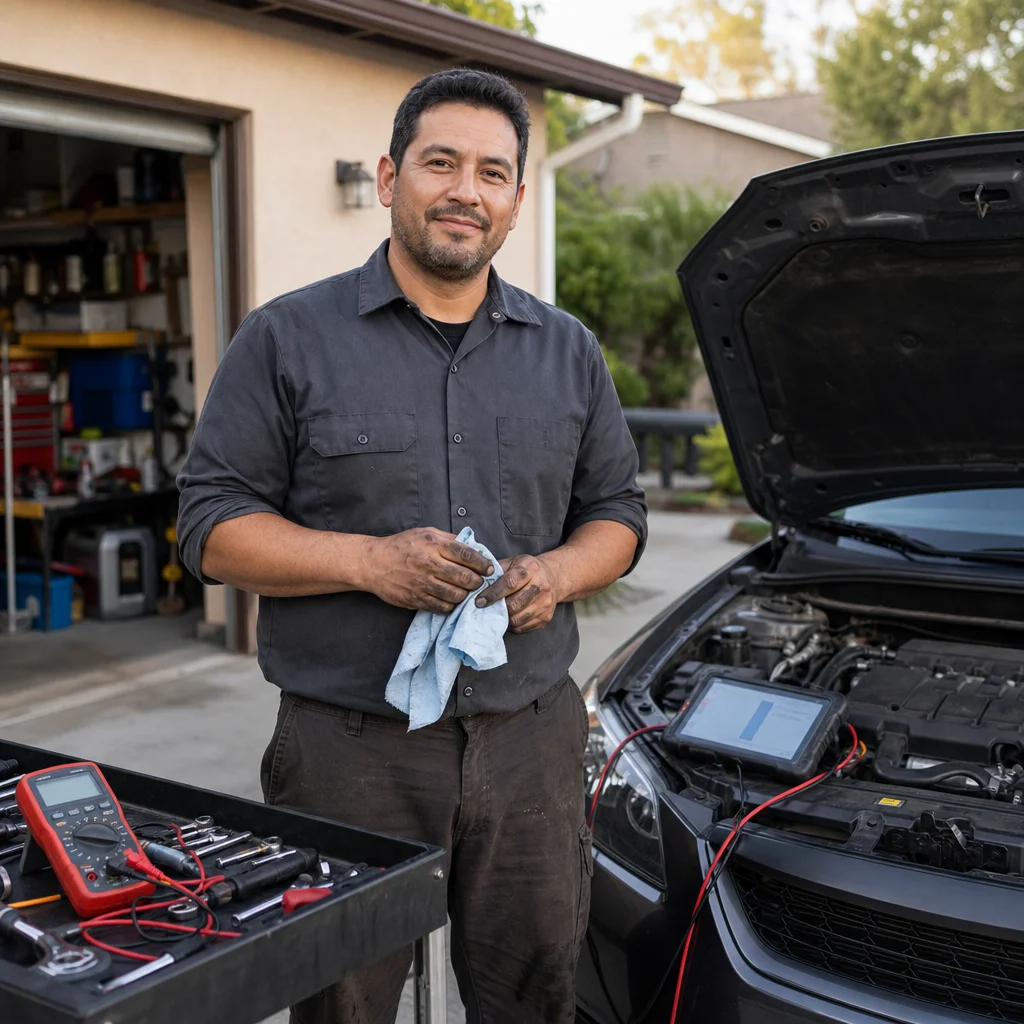
A new battery rules out one possibility, but it doesn’t prove that the starting system is healthy. If the engine still turns slowly, the problem may be the connection between the battery and starter, insufficient charging, excessive starter current draw, cold-weather conditions, or resistance inside the engine itself.
The most efficient approach is to test from the battery outward rather than replacing parts in sequence. Start with simple visual checks, then use voltage measurements to find where power is being lost. That usually gives you a better answer than relying on the battery’s age or the sound of the starter alone.
Start by confirming what “new battery” means
A replacement battery can be new to you without being fully charged. It may have been sitting on a store shelf, installed after repeated unsuccessful starting attempts, or selected with the wrong capacity for the vehicle. A battery with a low state of charge can crank slowly even when it passes a basic voltage check.
With the engine off and the vehicle undisturbed for several hours, a healthy, fully charged 12-volt battery will often measure close to 12.6 volts. A lower reading suggests that the battery needs charging or further testing, although voltage alone can't prove that the battery can deliver enough current under load. A battery tester or professional load test is more useful when the resting voltage looks reasonable but cranking remains weak.
Also check the battery’s physical specifications. The correct group size, terminal arrangement, reserve capacity, and cold-cranking rating depend on the vehicle and its climate. A battery can fit in the tray and still be a poor match for the engine, particularly in a cold Northern winter.
Confirm the starting-system specifications: Check your owner’s manual or manufacturer information for the required battery group, cold-cranking rating, oil viscosity, and test procedures. Exact values vary by engine and model year, so don't treat general voltage numbers as a substitute for vehicle-specific instructions.
Inspect the cables and grounds before blaming the starter
High current travels through the positive battery cable to the starter and returns through the engine block, ground strap, and negative battery cable. A loose terminal, hidden corrosion, damaged cable, or weak engine ground can restrict that current. The battery may be capable of starting the engine, but the starter never receives the power it needs.
Disconnecting and inspecting the terminals is worthwhile. Look for white, green, or blue corrosion, cracks in the terminal clamps, looseness, swollen cable insulation, and cables that feel unusually stiff or damaged near their ends. The terminals should be clean and tight, with the clamp gripping the battery post rather than merely appearing to sit on it. Inspect the negative cable where it attaches to the body and engine, and look for a separate braided ground strap between the engine, transmission, and chassis.
Cleaning a terminal can solve a genuine connection problem, but it won’t repair corrosion that has traveled inside the cable. If the terminal is tight yet the cable end becomes hot during cranking, resistance may be present at that connection. Heat is a useful clue, not a complete diagnosis; avoid touching components immediately after a prolonged start attempt.
A voltage-drop test is more informative than measuring resistance with the system disconnected. Set a multimeter to DC volts and place one probe on the battery’s positive post—not the cable clamp—and the other on the starter’s main power terminal. Have an assistant crank the engine briefly. The displayed voltage is the amount lost through the positive cable and its connections. Repeat on the ground side, placing one probe on the battery negative post and the other on clean metal on the starter or engine block.
The acceptable limits vary by vehicle and test method, but a noticeably higher drop on one side points toward that cable or its connections. This test has an important advantage over simply checking battery voltage: it shows what happens while the starter is demanding current. A basic cleaning is inexpensive and quick; replacing a cable or ground strap costs more but is appropriate when the cable itself is damaged or the drop remains excessive after the connections are corrected.
Separate low voltage from excessive starter demand
If the cables and grounds pass their checks, measure battery voltage while the engine is cranking. A momentary drop is normal because the starter draws substantial current. A sharp drop can indicate a weak or discharged battery, a battery with an internal defect, or unusually high starter demand. If voltage stays relatively strong but the engine turns slowly, the starter or mechanical load becomes more suspicious.
A starter can wear internally in several ways. Its brushes and commutator may be worn, bushings can allow the armature to drag, and the solenoid contacts can develop resistance. Some starters work acceptably when cold but crank slowly after the engine has been driven and heat has soaked into the starter. Repeated clicking, a single click with little rotation, or a slow groan can provide clues, but sounds aren't reliable enough to identify the failed part by themselves.
A current-draw test with an inductive ammeter can help compare starter demand with the vehicle manufacturer’s specifications. This is often a better job for a repair shop unless you already have the equipment and know how to use it safely. High current can damage a meter that is connected incorrectly, and the correct interpretation depends on engine size, temperature, battery condition, and cranking speed.
Replacing the starter immediately may restore normal cranking, but it is an expensive choice if a bad ground is the real cause. On the other hand, spending hours cleaning multiple connections may not be efficient when a confirmed starter current-draw problem is present. The trade-off is straightforward: use voltage-drop testing to rule out the relatively simple power-path problems before paying for a starter.
Account for cold temperatures and charging problems
Cold weather makes several parts of this diagnosis harder. Battery output falls as temperature drops, engine oil thickens, and the starter needs more torque to turn the engine. A battery that starts the vehicle easily in mild weather may struggle when temperatures fall below freezing, especially if it wasn't fully charged or has a marginal cold-cranking rating.
Use the oil grade specified for your engine and climate rather than choosing a thinner oil solely because cranking is slow. If the engine oil is overdue for service, contaminated, or visibly far above the correct level, it can add to the problem. A block heater may help in severe cold where one is appropriate, but it doesn't correct a poor battery connection or failing starter.
The charging system is another possibility, but the alternator usually can't explain a slow crank until the vehicle has run. It can explain why the replacement battery is repeatedly undercharged. Once the engine starts, measure charging voltage only according to the vehicle’s test requirements and inspect the serpentine belt, alternator connections, and warning lights. A charging-system fault, frequent short trips, or a parasitic electrical drain can leave a good battery too depleted for the next start.
A battery that repeatedly needs charging deserves a complete diagnosis. Installing another battery without checking alternator output and key-off current may only restart the cycle. If the engine starts normally after an external charge but becomes slow again after sitting overnight, distinguish between a charging problem and a drain rather than assuming the battery has failed.
Don’t overlook engine or accessory resistance
When battery voltage remains adequate, cable voltage drops are low, and the starter’s current draw isn't obviously abnormal, mechanical resistance deserves consideration. A seized or failing accessory, such as an alternator or compressor, can make the belt system difficult to turn. Internal engine problems can also increase resistance, though these are less common than poor connections or a tired starter.
Unusual symptoms matter here: a sudden change from normal cranking to near-lockup, a belt that stops or squeals heavily, abnormal noises, coolant or oil contamination, or an engine that turns unevenly. Testing whether the engine rotates by hand or removing a belt involves model-specific procedures and can create new risks if done incorrectly. Don’t force a crankshaft or place hands near belts and pulleys with the engine able to start.
If the engine cranks at normal speed but doesn't start, move to fuel, ignition, and engine-management diagnosis. Slow cranking and no-start problems can overlap, but replacing a starter won't fix an unrelated fuel or spark fault.
A sensible diagnostic order
Work through the least expensive, most revealing checks first:
- Confirm the battery’s size and rating, then charge and test it.
- Inspect and tighten both battery terminals and the main engine and body grounds.
- Check for damaged or overheated positive and negative cables.
- Perform positive- and ground-side voltage-drop tests during cranking.
- Measure cranking voltage and, when available, test starter current draw.
- Check charging performance after the engine runs normally.
- Investigate engine oil, belt-driven accessories, or internal mechanical resistance when electrical tests are satisfactory.
Repeated cranking can overheat the starter and drain the battery. Keep attempts brief, allow the starter to cool between tests, and follow the vehicle manual’s instructions for disabling fuel or ignition if a longer diagnostic crank is required. Keep the transmission in Park or Neutral, apply the parking brake, and keep tools, clothing, and hands away from moving parts.
If the battery and cable tests are good but the starter still draws excessive current or the engine remains slow, replacing or rebuilding the starter is the likely next decision. If voltage drops are high, repair the connection or cable instead. When the test results conflict, or when the engine may have mechanical damage, a shop with a proper battery tester, current clamp, and manufacturer data can be cheaper than guessing.
A new battery is a useful starting point, not a conclusion. Trace the power path under load, account for cold-weather demands, and verify the charging system after the engine is running. Those comparisons let you choose between a simple connection repair, a starter diagnosis, or professional testing with much less unnecessary parts swapping.