How to Tell Whether a Diesel’s Glow Plugs or Battery Cause Hard Cold Starts
I’ll explain how to separate a weak battery from failing glow plugs during a hard diesel cold start, using cranking speed, exhaust smoke, preheat behavior, voltage checks, and scan data to choose the next sensible test.
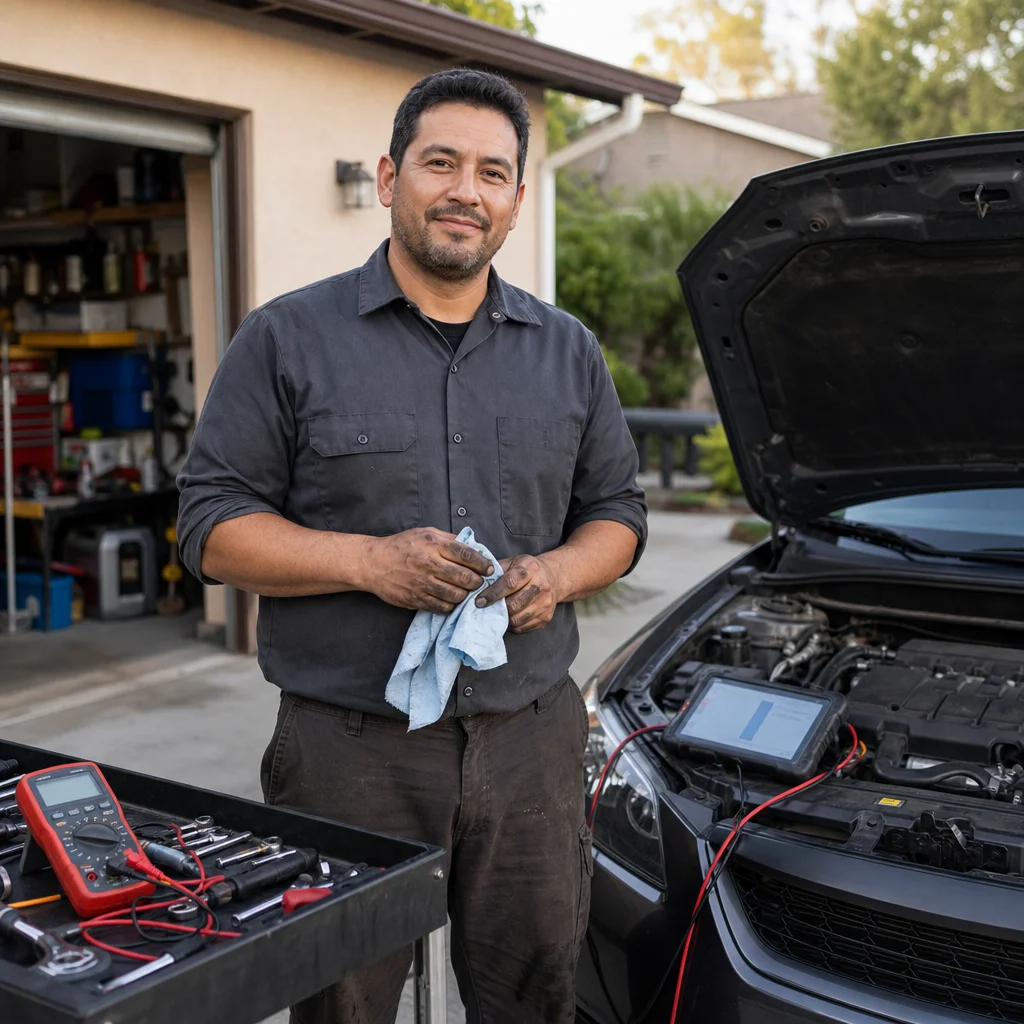
Cold weather makes several diesel starting problems look alike. A weak battery can turn the engine too slowly to build heat and compression, while failed glow plugs can leave the engine cranking at normal speed but unable to ignite the first fuel charge. A sticking glow-plug controller, poor cable connection, incorrect oil viscosity, or a fuel problem can produce similar symptoms.
The most useful approach is to observe what happens during the first start of the day, then test the battery and preheat system rather than replacing parts by guesswork. Start with cranking speed and preheat behavior, because those clues often tell you which system deserves attention first.
Start with what the engine is doing
Pay attention to the sound and timing of the start. If the starter turns the engine noticeably slower than usual, especially with a labored or uneven rhythm, suspect the battery, battery connections, starter, or engine oil before blaming the glow plugs. Diesel engines need substantial cranking speed to generate enough heat for ignition, so a battery that can still operate lights and accessories may not be strong enough for a cold start.
If the engine spins at a steady, reasonably quick speed but takes several seconds to fire, the glow-plug system becomes more likely. That is particularly true when the problem is much worse below freezing and improves after the engine has warmed up. A diesel that starts promptly when warm but struggles only when cold often has a preheat problem, although poor compression and fuel issues remain possible.
Listen for what happens after the engine catches. A brief rough idle can be normal in severe cold, but prolonged shaking, misfiring, or repeated white smoke suggests that one or more cylinders are receiving fuel without burning it cleanly. That can result from a bad glow plug, but it can also point to low compression, an injector fault, incorrect injection timing, or air in the fuel system.
Use smoke as supporting evidence
Smoke color is helpful only when combined with cranking behavior. Thin white or gray smoke during extended cranking usually means fuel is entering the cylinders but isn't igniting completely. On a cold engine, failed glow plugs are one possible cause. White smoke that continues after the engine warms deserves further diagnosis rather than an automatic glow-plug replacement.
Little or no exhaust smoke while the engine cranks points in a different direction. It may indicate that fuel isn't reaching the cylinders, perhaps because of a fuel shutoff issue, a pressure problem, a clogged filter, air entering the fuel supply, or an electronic control fault. A healthy glow system can't compensate for a lack of fuel.
Black smoke is generally associated with too much fuel or too little air once the engine is running. It isn't the usual clue for a simple glow-plug failure during cranking. Don't use smoke alone to make the diagnosis; cold ambient conditions, exhaust design, and lighting can make its color difficult to judge.
Check the battery before removing glow plugs
A battery test is usually the most efficient first electrical check. Let the vehicle sit long enough for its surface charge to dissipate, then measure voltage directly across the battery posts, not just the cable terminals. A fully charged 12-volt battery often measures near 12.6 volts at rest, while a substantially lower reading indicates either a discharged battery or a battery that is losing capacity. Exact readings vary with temperature and battery type.
Next, measure voltage while the engine is cranking. A sharp drop indicates that the battery may not be able to supply the required current, but the result must be interpreted with the test conditions and vehicle specifications in mind. Cold temperatures reduce available battery capacity, and a battery can show an acceptable resting voltage while failing under load.
Confirm your test limits: Before condemning the battery or glow plugs, check the owner’s manual or service information for the battery’s required cold-cranking rating, the manufacturer’s minimum cranking voltage, and the correct glow-plug test procedure. Some modern systems use low-voltage glow plugs that can be damaged by an unsuitable direct-power test.
Inspect the battery terminals, ground connection, and positive cable for looseness, corrosion, swelling, or heat damage. A voltage-drop test while cranking can reveal resistance that a simple battery-voltage check misses. Measure between the battery positive post and the starter’s positive connection, then between the battery negative post and a clean point on the engine block. Excessive voltage drop means current is being lost through a cable or connection.
If the battery and cables test well but the engine still cranks slowly, the starter or an engine-related mechanical problem may be responsible. Thick or incorrect oil can also add considerable resistance in cold weather. A slow crank isn't proof of a bad battery.
Evaluate the glow-plug system
Glow plugs heat the air or combustion chamber before and, on many engines, during the initial part of a cold start. The dashboard glow-plug lamp is only a broad indication that the control system has begun a timed cycle. It doesn't prove that every plug is heating, and a normal-looking lamp doesn't rule out a failed plug, wiring fault, relay, or control module.
Turn the key to the preheat position without cranking and observe the lamp. A lamp that never illuminates, flashes unexpectedly, stays on much longer than usual, or behaves differently from the vehicle’s normal pattern is worth investigating. However, modern diesels can adjust preheat time according to coolant temperature and other inputs, so a short lamp cycle on a mildly cold day may be normal.
The next step is to determine whether the glow plugs receive the correct power. Depending on the vehicle, a relay or electronic module may supply voltage in pulses or regulate it instead of providing a simple constant feed. Test at the glow-plug connector with the proper procedure for that engine. Seeing battery voltage at one moment isn't enough if the module is using pulse-width control or if the test is made after the preheat cycle has ended.
Individual glow plugs can also be tested for resistance, but resistance values are often very low and vary by design. An inexpensive meter may not resolve the difference between a healthy plug and a marginal one. A plug that reads open circuit is clearly suspect, but a normal-looking resistance reading doesn't always prove that it heats correctly under operating conditions.
Current-draw testing can be more informative when the required equipment and specifications are available. A failed plug may reduce the total current draw, while a wiring or module problem can affect all of the plugs. Remove the electrical connector carefully and follow the manufacturer’s instructions; applying power directly or grounding the wrong terminal can damage the controller or a low-voltage plug.
Let scan data narrow the decision
A diagnostic scan tool can provide clues even when the check-engine light is off. Look for glow-plug circuit codes, glow-control-module faults, low-voltage codes, coolant-temperature readings, and rail-pressure data where the vehicle supports it. A coolant-temperature sensor reporting a much warmer engine than the actual ambient temperature may cause the control system to shorten preheat, creating a cold-start problem without a failed glow plug.
Live data during cranking is also useful. Compare engine speed, system voltage, fuel pressure, and synchronization information with the manufacturer’s expected values. Low cranking RPM or a substantial voltage collapse supports a battery, cable, starter, or oil-related diagnosis. Normal cranking speed with correct fuel pressure but difficult cold ignition shifts attention toward glow plugs or their control circuit.
Not every scan tool can access manufacturer-specific glow-plug data, and a stored code doesn't identify the failed component automatically. For example, a control-module code may result from a power supply or ground problem rather than the module itself. Treat scan data as a way to choose the next test, not as permission to replace every part named by a code.
Separate common look-alikes
A block heater can change the outcome dramatically. If the engine starts normally after being plugged in but struggles when left outside, the result confirms that heat matters but doesn't distinguish glow plugs from weak battery performance or thick oil. Compare battery voltage, cranking speed, and preheat operation rather than using the block heater as a diagnosis.
Fuel quality and fuel delivery should move higher on the list if the problem began after service, a filter change, or extremely cold weather. Water in diesel fuel, a restricted filter, waxing, air leaks, or loss of prime can cause extended cranking and white smoke. Follow the vehicle’s fuel-system procedure, since some common-rail systems operate at dangerous pressures.
Low compression, injector problems, and valve-timing faults are less convenient possibilities, but they should be considered when the battery, glow system, and fuel supply check out. A diesel that starts poorly in all temperatures, consumes excessive oil, or produces persistent smoke needs broader mechanical testing.
A sensible testing order
Begin with a fully charged battery and clean, tight connections. Observe cranking speed, smoke, and the preheat lamp during a genuinely cold start. Then check resting and cranking voltage, perform cable voltage-drop tests, and scan for relevant codes and live-data abnormalities. If the engine cranks normally, test glow-plug power and individual plugs using the correct specifications for that model.
Avoid repeated long cranking sessions. They can overheat the starter, drain the battery, and fill the cylinders with unburned fuel. Keep the transmission in Park or Neutral, set the parking brake, and stay clear of belts, fans, and other moving parts. Never use starting fluid on a diesel with active glow plugs unless the manufacturer explicitly specifies a safe procedure; ignition can occur prematurely and cause severe engine damage.
The practical decision is straightforward: slow cranking points first toward battery capacity, cables, the starter, or oil; normal cranking with white smoke and cold-only difficulty points more toward preheat or combustion issues; and little smoke points toward fuel delivery or control. Confirm those clues with voltage tests, glow-system checks, and scan data before buying parts. If high-pressure fuel testing, compression testing, or controller diagnosis is required, handing the vehicle to a qualified diesel technician is usually the safer and more efficient next step.