Why Does an Engine Consume Coolant With No Visible Leak?
I’ll compare the most likely reasons an engine loses coolant without leaving a puddle, from hidden external leaks to head-gasket problems. You’ll learn which clues matter, which tests can separate the possibilities, and when continued driving risks serious damage.
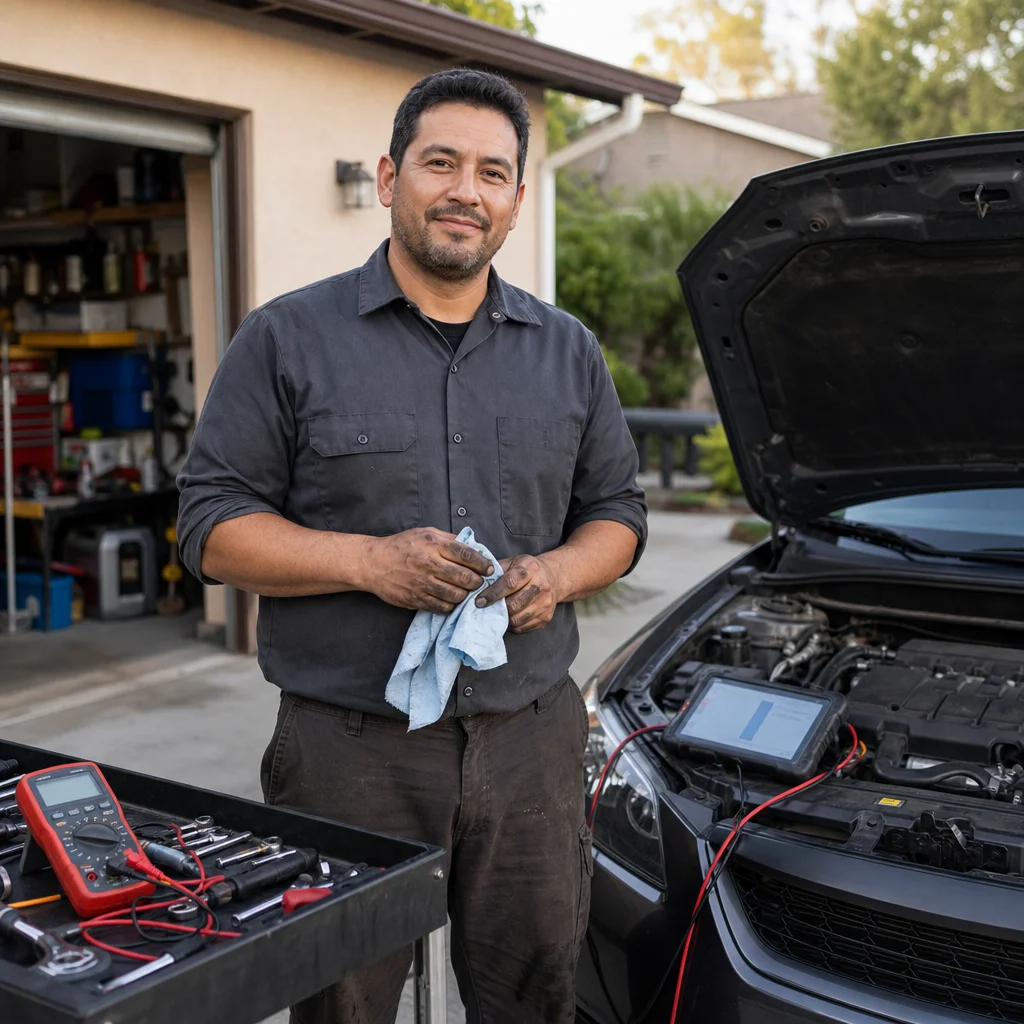
Coolant loss is easy to underestimate when there’s no bright-colored puddle under the vehicle. A small leak may evaporate on a hot engine, while a more serious problem can send coolant into the cylinders, exhaust, or engine oil instead of onto the ground.
The useful question isn’t simply whether the engine is “using” coolant. It’s where the coolant is going, how quickly the level drops, and what other symptoms appear with it. A careful diagnosis can often narrow the problem before you authorize major engine work.
Start by confirming that coolant is actually disappearing
Check the coolant level only when the engine is fully cold and parked on level ground. Use the markings on the expansion tank or radiator neck as appropriate for your vehicle, and note the level rather than relying on memory. If the level is below the mark, top it up with the coolant specified in the owner’s manual, then record the date and mileage.
Don’t use the overflow tank as a precise measurement if the engine was recently hot, the vehicle is parked on an incline, or the tank markings are difficult to read. A changing level can sometimes reflect trapped air being purged after cooling-system work, but repeated losses after the system has stabilized need investigation.
Also check whether the warning is based on a sensor rather than a visual inspection. A faulty level sensor, a damaged tank, or a loose electrical connector can trigger a warning even when the coolant level is acceptable. Conversely, some vehicles don’t provide an early low-coolant warning at all.
Check it without getting burned: Never remove a radiator cap or pressurized expansion-tank cap while the engine is hot. Hot coolant can erupt under pressure. Let the system cool completely, keep your hands and clothing away from belts and fans, and follow the vehicle’s instructions for checking the level.
Hidden external leaks are often the first possibility
A leak doesn’t have to form a puddle. Coolant can escape as a fine mist or seep onto a hot engine, exhaust component, or radiator surface, where it evaporates before reaching the ground. Dried coolant may leave a white, green, pink, orange, or crusty residue, although the color varies by coolant type and can be difficult to see on a dirty engine.
Inspect the coolant reservoir, radiator seams, hoses, clamps, thermostat housing, water pump area, and heater-hose connections. Look for dampness, staining, swollen hoses, or a sweet smell after the vehicle has been driven. A water pump may leak from a small drain opening near its pulley; the location can be hard to see without removing a cover, splash shield, or other component.
A leak may also appear only when the system is hot and pressurized. That’s why a dry inspection of a cold engine doesn’t rule out an external leak. A cooling-system pressure test applies controlled pressure while the engine is off, giving coolant time to seep from a weak connection or component.
Pressure testing is useful, but it should be done with equipment that matches the vehicle and without exceeding the specified pressure. A professional can also use UV dye and a suitable lamp to trace a small leak. Dye can help, but it isn’t a substitute for finding the actual failed seal, hose, radiator, or housing.
A heater-core leak can hide inside the cabin
Coolant circulating through the heater core can leak inside the dashboard or passenger compartment. Common clues include a sweet odor through the vents, fogging or a greasy film on the inside of the windshield, damp carpet near the front footwells, or unexplained moisture in the cabin.
Some heater-core leaks are small enough to produce odor before they create obvious wetness. Others drain through the vehicle in a way that leaves little evidence beneath the engine bay. If the windshield fogs with a persistent film or the cabin smells strongly of coolant, don’t dismiss it as a normal ventilation issue.
A leaking heater core can also affect visibility if coolant vapor reaches the glass. Avoid driving if the windshield can’t be kept clear, and remember that coolant inside the cabin is both a health concern and a sign that the cooling system is losing pressure or fluid.
Internal leaks require closer attention
If a pressure test shows no external leak, coolant may be entering the engine or exhaust system. A failed head gasket is one possibility, but it isn’t the only one. Depending on the engine design, coolant can pass through a damaged cylinder-head gasket, a cracked cylinder head or block, an intake-manifold gasket, an exhaust-gas recirculation cooler, or a turbocharger coolant circuit.
Coolant entering a combustion chamber may produce persistent white exhaust vapor with a sweet odor, especially after the engine is warm. Normal condensation can also create white vapor during a cold start, particularly in cool or humid weather. The important distinction is whether the vapor continues after warm-up, becomes unusually heavy, or accompanies coolant loss, rough running, or overheating.
A cylinder that receives coolant may misfire during startup. In severe cases, the engine can be difficult to crank because liquid doesn’t compress like the normal fuel-and-air mixture. Don’t repeatedly crank an engine that suddenly locks, turns unusually slowly, or has a severe misfire after losing coolant.
A combustion-gas test can check whether exhaust gases are entering the cooling system. A cooling-system pressure test may reveal pressure loss, but a result that appears normal doesn’t eliminate every internal leak. A technician may need compression testing, a leak-down test, spark-plug inspection, or a borescope examination to build a stronger diagnosis.
Check the oil, but don’t treat one clue as proof
Coolant and engine oil can mix if a gasket, cooler, or casting fails. Coolant contamination may make the oil look tan, milky, or unusually foamy, especially under the oil-fill cap or on the dipstick. That appearance is a warning sign, but short trips and condensation can sometimes create light deposits under the cap without a major coolant leak.
Look at the oil level as well as its appearance. An oil level that rises unexpectedly can indicate that another fluid is entering the crankcase. On the other hand, a normal-looking dipstick doesn't rule out an internal coolant leak; coolant may be burning in a cylinder or passing through a separate cooler without mixing with the oil.
If the oil is contaminated, avoid normal driving. Coolant can reduce lubrication and damage bearings, while overheating can cause additional engine damage. The vehicle may need to be towed for diagnosis rather than driven to a repair shop.
Use the pattern of symptoms to narrow the cause
The rate of coolant loss provides useful context. A few drops over a long interval may point to a minor seep, an evaporating leak, or a cap that isn’t holding pressure. A reservoir that empties over a short drive, a rapidly falling level, or repeated overheating indicates a more urgent fault.
Pay attention to when the symptoms occur. Coolant loss after highway driving may reflect a leak that opens under higher temperature and pressure. Loss after parking can point to a hose, tank, radiator, or water-pump leak that continues as the system cools. A rough cold start followed by persistent white exhaust points the investigation in a different direction.
Watch the temperature gauge, but don’t rely on it as the only warning. Some gauges remain near the normal position until the engine is already dangerously hot, and an air pocket can prevent a sensor from accurately representing the hottest part of the engine. Overheating, a coolant warning, steam, loss of cabin heat, or a flashing check-engine light should be treated seriously.
A sensible diagnostic order
Begin with the least invasive checks: confirm the level cold, inspect for residue and odors, look inside the cabin, and check the oil. Then inspect or test the cap and pressurize the cooling system if you have the correct equipment and know how to use it safely. UV dye can help reveal a hidden external leak.
If the system holds pressure but coolant continues to disappear, move toward internal-leak testing. A combustion-gas test, spark-plug comparison, compression test, leak-down test, and borescope inspection each answer slightly different questions. No single test is perfect in every engine, so the results should be considered together.
Avoid replacing a head gasket solely because the engine is losing coolant. A failed radiator seam, water pump, heater core, intake gasket, or EGR cooler can create similar symptoms, and the repair cost and procedure may be very different. Confirming the leak path is more valuable than guessing the most expensive failure first.
When driving is no longer a reasonable gamble
Stop driving and arrange a repair or tow if the engine overheats, the coolant level drops rapidly, steam appears, the oil looks contaminated, the engine misfires severely, or the temperature warning returns after topping up. Continuing to drive with inadequate coolant can turn a repairable cooling-system problem into warped or cracked engine components.
If the loss is minor and the engine remains at its normal temperature, a short trip may seem uneventful, but that doesn’t make the fault safe to ignore. Carrying extra coolant isn't a repair, and adding water may be unsuitable for anything beyond an emergency measure because the correct coolant concentration and corrosion protection still matter.
Coolant additives or “stop-leak” products can sometimes provide a temporary result, but they may restrict small passages, affect heater performance, or complicate later repairs. Use one only if the vehicle manufacturer or a qualified professional specifically recommends it for that application.
The best next step is to document the cold level, mileage, warning lights, odors, exhaust behavior, and any visible residue. That information helps separate evaporation from an external pressure leak and an internal engine problem. If a pressure test and basic inspection don’t reveal the cause, professional testing is justified—especially before assuming the engine needs major work.