What Does a Catalytic Converter Efficiency Code Usually Mean?
A catalytic-converter efficiency code can point to an aging converter, but it can also result from an exhaust leak, sensor problem, or engine fault. I’ll explain how the code is set, what to test first, and which mistakes can make an expensive repair unnecessary.
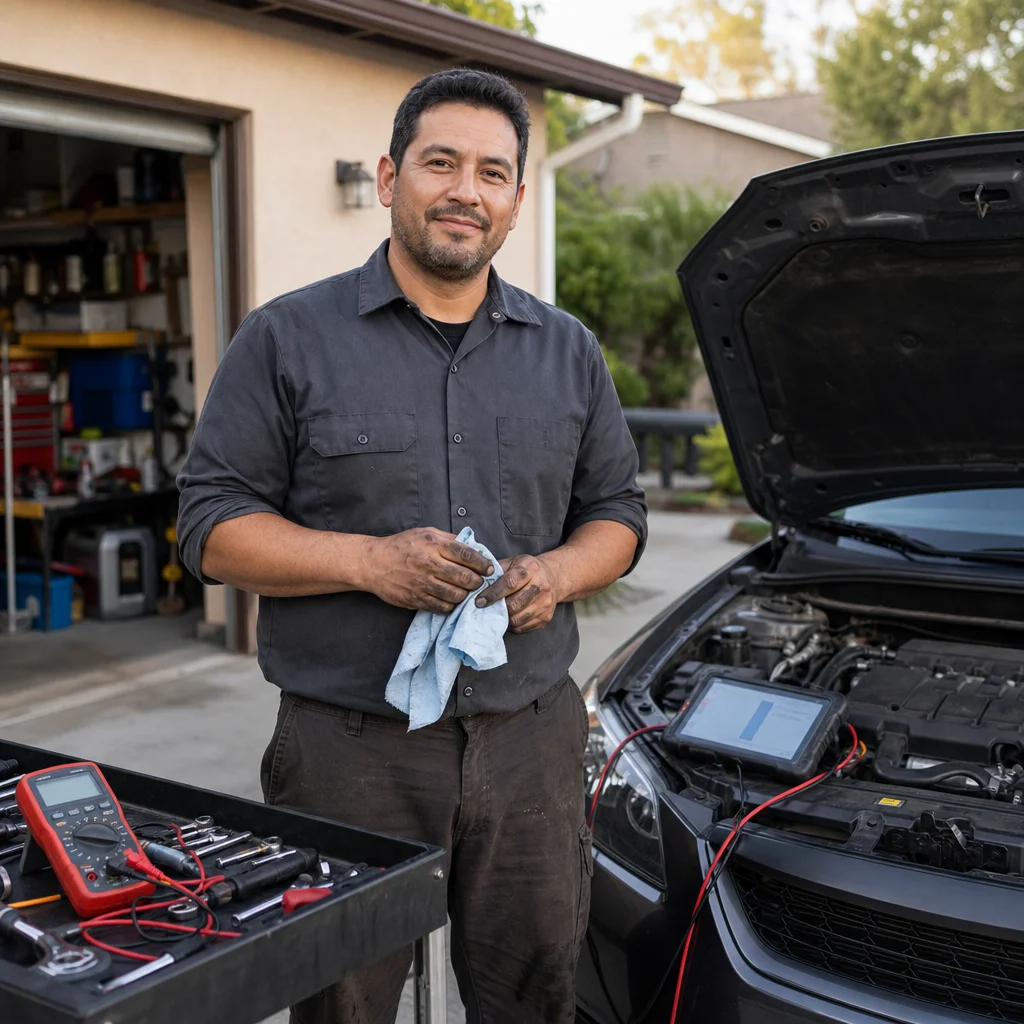
A catalytic-converter efficiency code is easy to misread as a direct order to replace the converter. In practice, codes such as P0420 for Bank 1 or P0430 for Bank 2 tell you that the engine computer is seeing less emissions-cleaning activity than expected. That result can come from the converter, but it can also be caused by inaccurate sensor readings, exhaust leaks, or an engine problem that has damaged the converter.
The most useful approach is to treat the code as a starting point for diagnosis rather than a parts recommendation. You’ll want to determine whether the converter is actually failing, whether the sensors are reporting accurately, and whether another problem is sending harmful exhaust through the converter.
What the efficiency code is measuring
A typical gasoline vehicle uses an oxygen sensor before the catalytic converter and another one after it. The upstream sensor helps the engine computer adjust the air-fuel mixture. The downstream sensor primarily monitors how well the converter is processing the exhaust.
A functioning converter stores and releases oxygen as it changes pollutants into less harmful gases. Because of that activity, the downstream oxygen reading should generally be steadier than the upstream reading. The computer watches the sensor signals over time and compares their patterns. If the downstream signal begins to resemble the upstream signal too closely, the computer may conclude that the converter isn't storing oxygen effectively enough.
That is what an efficiency code usually means: the measured oxygen-storage performance fell below the vehicle manufacturer's threshold under particular operating conditions. It doesn't necessarily mean the converter has stopped working completely. The threshold and testing conditions vary by vehicle, so the exact diagnostic procedure belongs to the service information for your make, model, engine, and year.
P0420 normally identifies the converter on Bank 1, the side containing cylinder 1. P0430 normally identifies Bank 2 on an engine with two cylinder banks. On an inline engine, there is usually only one bank. The code designation helps locate the system, but it doesn't identify the failed component by itself.
Why replacing the converter first can be a mistake
A converter can fail internally, but it is often the victim of another problem. A persistent misfire, an overly rich mixture, leaking fuel injector, incorrect fuel pressure, or an engine that burns oil or coolant can overheat or contaminate the catalyst. If you install a new converter without correcting that cause, the replacement may be damaged quickly.
An exhaust leak can also create a false efficiency concern. A leak ahead of, or close to, the downstream oxygen sensor can draw outside air into the exhaust stream during pressure changes. That added oxygen can alter the sensor signal and lead the computer to believe the converter is performing poorly. Small leaks around a manifold, flange, flex pipe, or sensor bung can be difficult to hear, especially when the exhaust is cold.
The oxygen sensors themselves can be slow, contaminated, or affected by wiring problems. A sensor may still produce a plausible voltage while responding too slowly or inaccurately. Damaged wiring, poor electrical connections, and a sensor that isn't the correct application can produce misleading data. Clearing the code and replacing a sensor without testing the circuit isn't a reliable diagnosis.
Some vehicles are more sensitive to exhaust and sensor conditions than others. Software updates, known service bulletins, and manufacturer-specific test procedures can matter. That is one reason a generic internet explanation or a parts-store scan shouldn't be treated as the final answer.
Check your vehicle’s test conditions: Before judging the code, look up the manufacturer’s diagnostic procedure for your exact vehicle and confirm whether there are related codes, software updates, or required drive-cycle conditions.
A sensible diagnostic order
Start by scanning for all stored, pending, and permanent diagnostic trouble codes. Don't focus only on P0420 or P0430. Misfire codes, fuel-trim codes, oxygen-sensor codes, air-fuel-ratio sensor codes, and coolant-temperature codes may reveal the problem that caused the efficiency code. Freeze-frame data can also show the engine speed, load, temperature, and fuel-trim conditions present when the computer set the code.
If the check-engine light is flashing, treat that as a more urgent problem than a steady efficiency light. A flashing light commonly indicates an active misfire that can overheat the converter. Avoid driving farther than necessary and address the misfire before evaluating converter efficiency. Continuing to operate the vehicle under a severe misfire can turn a repairable ignition or fuel problem into converter damage.
Next, inspect the exhaust system from the engine to the converter and around the downstream sensor. Look for black soot marks, cracked welds, loose fasteners, damaged pipe, and signs that a flange or gasket is leaking. Do this only with the vehicle securely supported and the exhaust fully cool. Never crawl under a vehicle held up only by a jack.
A smoke test is often more useful than simply listening for a leak. If you use an exhaust smoke machine, follow the equipment instructions and avoid pressurizing the system beyond its design limits. A professional shop can usually locate small leaks more efficiently, particularly when heat shields or limited access hide the source.
Then check for obvious engine-running problems. Review short- and long-term fuel trims, misfire counters, coolant temperature, fuel-system status, and oxygen-sensor or air-fuel-sensor data with a capable scan tool. The interpretation depends on the vehicle, so one universal voltage number shouldn't be used as a pass-or-fail test.
Compare the upstream and downstream sensor behavior after the engine reaches normal operating temperature. On many conventional systems, the upstream signal changes frequently as mixture control operates, while the downstream signal remains comparatively stable. A downstream signal that closely follows the upstream signal can support a weak-converter diagnosis, but scan-tool graphs, sensor type, exhaust leaks, and manufacturer strategy all affect what the readings mean.
A good diagnosis also checks whether the converter reaches and maintains the expected temperature pattern. Infrared temperature measurements can provide clues, but they are easy to misinterpret. Surface temperature varies with converter design, exhaust flow, engine load, and measurement location. Temperature testing should supplement, not replace, code analysis and checks for leaks and engine faults.
Common mistakes that make the problem worse
The most common mistake is replacing the most expensive-looking part first. A converter may be the final failed component, but the parts bill doesn't prove the cause. Diagnose the engine and exhaust conditions that could have caused the failure before installing anything.
Another mistake is clearing the code and assuming the repair worked because the light stays off for a short drive. The efficiency monitor may not run until the vehicle meets specific conditions involving coolant temperature, speed, load, and time. After a battery disconnect or code clear, the emissions monitors may also show as incomplete. A repair should be verified using the vehicle's monitor status and an appropriate drive cycle, not just a temporarily dark warning lamp.
It is also easy to overlook recent repairs. A damaged sensor wire, loose exhaust connection, incorrect gasket, or sensor installed in the wrong location can appear soon after exhaust work. Inspect anything that was disturbed before assuming the converter suddenly failed.
Avoid adding unverified cleaners or additives as a substitute for diagnosis. A chemical product may not repair a melted, contaminated, or physically damaged catalyst, and it can distract from a misfire or fuel problem that continues to create damage. Likewise, don't use a non-approved replacement converter simply because it is cheaper without checking fitment and emissions requirements for the vehicle.
Verify the replacement before ordering: Confirm the correct converter application, emissions configuration, and legal requirements for your vehicle and location; emissions-component rules and inspection requirements can change, and the vehicle’s certification label and current state guidance are more reliable than a generic listing.
When the converter itself is the likely problem
The converter becomes a stronger suspect after related engine and exhaust faults have been ruled out, the sensors and their wiring respond correctly, and the efficiency monitor repeatedly fails under the specified conditions. Physical evidence such as a rattling substrate, restricted exhaust flow, or a catalyst that has melted from an earlier misfire adds support to the diagnosis.
A converter that is restricted may cause poor acceleration, reduced engine power, or unusual vacuum behavior under load. A converter that has lost efficiency may cause only a warning light and no noticeable drivability change. These are different failure patterns, and a vehicle can have one without the other.
If the converter has failed because of contamination or overheating, find the cause before fitting the replacement. Check for unresolved misfires, fuel-control problems, oil consumption, coolant entry, and exhaust leaks. Otherwise, the new part is being asked to absorb the same problem that damaged the old one.
Converter replacement can involve seized fasteners, extreme heat, sharp shields, and difficult access. If the unit is integrated into the exhaust manifold, requires welding, or is located near sensitive components, professional diagnosis and installation may be the sensible choice. A shop can also perform manufacturer-specific tests and confirm that the replacement meets the vehicle’s emissions configuration.
Practical next steps
If you have a steady check-engine light with P0420 or P0430, begin by recording every code and freeze-frame detail rather than clearing anything. Check for misfires and fuel-control faults, inspect for exhaust leaks, and review the oxygen-sensor data with the engine fully warm. Those steps often separate a converter problem from a cheaper and more important underlying fault.
If the light is flashing, the engine is misfiring, the vehicle has lost substantial power, or you smell raw fuel or overheated materials, limit driving and seek qualified help. When the evidence points to a failed converter, choose a correctly specified replacement and verify the repair by confirming that the relevant monitor runs without the code returning. The goal isn't merely to turn off the light; it is to restore the engine and emissions system that caused the warning in the first place.