How to Lift a Vehicle Safely on Uneven Residential Pavement
When a driveway slopes, cracks, or gives slightly under your feet, lifting a vehicle becomes a stability problem as much as a jack-placement task. I’ll explain how to reduce common risks and when uneven residential pavement makes roadside or professional help the wiser choice.
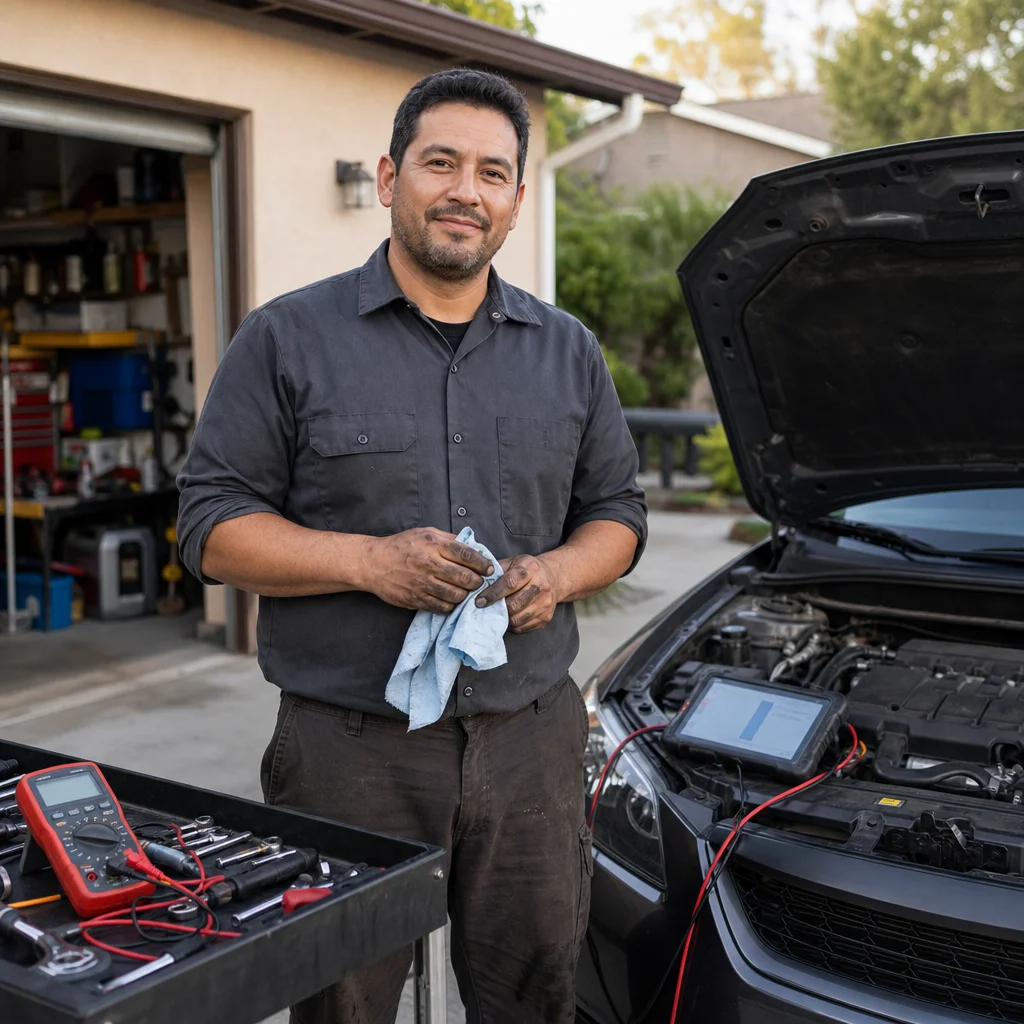
A sloped or uneven driveway can make a routine repair much more hazardous. The jack may roll, the vehicle can shift as its weight transfers, and a jack stand may settle or tip if its base isn't fully supported. Even a small-looking slope deserves attention before you lift a wheel.
For a beginner, the safest approach is to treat uneven residential pavement as a reason to change locations, not as a challenge to overcome with extra care. A flat, hard, intact surface is the right foundation. If you can't find one, postponing the repair or calling for help is usually the sensible decision.
Why uneven pavement changes the risk
A vehicle is most stable when its weight is distributed over a broad, level base. When you raise one end, the center of gravity shifts and the tires still on the ground become important contact points. On a slope, that shift can encourage the vehicle to move downhill or cause the jack to lean as it carries the load.
Residential pavement can also be deceptive. A driveway may look flat while having a noticeable crown, drainage slope, broken edge, or low spot. Asphalt that feels solid in one area may be soft near an edge, especially in hot weather or after heavy rain. Pavers, loose gravel, and patched concrete can let a jack wheel or stand foot settle unevenly.
A floor jack is designed to lift while its wheels or casters move slightly as the vehicle rises. If the jack is prevented from rolling by a curb, rough surface, crack, or soft ground, it can pull sideways on the lifting point. A small movement at the jack can become a much larger movement at the vehicle.
Start with the location, not the jack
Look for a level section of sound concrete or well-maintained asphalt that is large enough for the vehicle, the jack, the stands, and you. Keep the entire setup away from drainage channels, driveway edges, damaged pavement, grass, mud, and loose stones. Don't place one side of the vehicle on a different surface from the other if that creates a slope or uneven support.
A residential street may appear flatter than a driveway, but it introduces traffic and visibility hazards. It may also be crowned for drainage or subject to local parking restrictions. A public road isn't automatically an acceptable repair location simply because it is paved.
Confirm the lifting points first: Check the vehicle owner’s manual before positioning the jack or stands. The approved points, permitted support locations, and any instructions about wheel chocks or parking-brake use vary by vehicle.
If the only available location slopes enough that you can feel the vehicle’s weight pulling downhill, don't lift it there. Parking with the wheels turned toward a curb isn't a substitute for level ground, and a curb shouldn't be treated as a structural stop for a vehicle being raised.
Prepare the vehicle before raising it
Remove unnecessary people and items from around the vehicle. Keep the doors closed, and avoid climbing in or out once the vehicle is supported. Set the transmission in Park for an automatic or in gear for a manual transmission, unless the manufacturer gives a specific instruction for the repair. Apply the parking brake where appropriate.
Chock the wheels that will remain on the ground. For example, if you are lifting the front, place properly sized chocks at the front and rear of at least one rear tire; if you are lifting the rear, chock the front tires. Chocking both sides of the remaining grounded wheels gives additional protection against rolling. The chocks must contact the tire firmly and sit on the same hard, stable surface as the vehicle.
Chocks don't make a steep or unstable location safe. They are a backup measure, not a replacement for a level work area. Don't rely on the transmission, parking brake, or a single chock to restrain a vehicle while you lift it.
Before lifting, gather a floor jack with enough capacity for the vehicle and a pair of appropriately rated jack stands. The capacity markings should be clear and legible. Use stands that can support the vehicle at the intended height, not improvised supports such as bricks, timber stacks, buckets, or concrete blocks. A spare tire isn't a substitute for a stand.
Lift only at approved points
Inspect the jack, stands, and chocks before use. The jack should move smoothly, have no visible hydraulic leaks, and have a saddle that isn't damaged or badly worn. Make sure the stand’s height-adjustment mechanism and locking feature operate correctly. If equipment is damaged, bent, corroded, or missing its rating information, don't use it for this job.
Position the jack exactly where the manual or the vehicle’s service information specifies. Some vehicles have reinforced pinch-weld locations; others use a frame section, subframe, axle housing, or designated central lifting point. A thin floor pan, suspension arm not approved for lifting, exhaust component, oil pan, differential cover, or plastic panel may bend or break.
The jack saddle should sit squarely on the approved point. Keep the jack aligned with the vehicle rather than approaching at an angle. On uneven pavement, don't compensate for a poor position by placing a loose board, stone, or other object under the saddle. A load-spreading pad may be appropriate in some situations, but only if it is stable, strong enough, and consistent with the jack and vehicle manufacturer’s instructions.
Pump the jack slowly while watching the contact points, the jack’s base, and the tires on the ground. Stop immediately if the jack rolls unexpectedly, tilts, sinks, twists, or begins to slide. Also stop if the vehicle shifts, a chock moves, or a stand can't be placed on a flat, solid area.
Transfer the load to jack stands
Raise the vehicle only high enough to place the stands at their approved support points. Keep the stands as close as practical to the lifting area without interfering with the repair. Both stand feet need to sit completely on firm, level pavement. Never put one foot over a crack, soft edge, loose aggregate, or a change in surface height.
Set the stands to equal or otherwise appropriate heights according to the vehicle and the repair. Their saddles should meet the approved support points evenly. Lower the vehicle slowly onto the stands while keeping your hands, feet, and body out from underneath. Don't reach under the vehicle to guide a stand or check its contact.
Once the vehicle is resting on the stands, leave the jack lightly positioned as a secondary support if the vehicle and jack arrangement allow it, but don't treat the jack as a replacement for correctly placed stands. Never work beneath a vehicle supported only by a hydraulic jack; hydraulic pressure can be lost, and the jack can move.
From outside the vehicle’s footprint, look at each stand and contact point. The stands should remain upright, their bases should stay fully planted, and the vehicle should sit securely rather than press against an edge. A gentle stability check from a safe position may reveal movement, but don't deliberately rock the vehicle aggressively. If anything shifts, stop, clear the area, and lower the vehicle only when you can do so without putting yourself underneath it.
Common mistakes that cause trouble
One common mistake is lifting one side of a vehicle on a sloped driveway because the repair appears short. The length of the repair doesn't reduce the force involved if the vehicle moves. Another is placing a jack stand on a scrap of plywood or a loose board to “level” it. A board may split, slide, or tilt under load, particularly on damaged or sloping pavement.
People also sometimes chock the wrong wheels, forget that the chock itself can slide, or assume the parking brake secures every wheel. Many parking brakes act on only one axle, and their effectiveness can vary with the vehicle and surface. Use proper chocks at the grounded tires and follow the vehicle’s instructions.
Don't lift higher than necessary. Extra height increases the amount of movement possible and makes the setup more vulnerable to a shift. If you need substantial clearance, use a suitable lift or have the work performed by a shop equipped for it rather than stacking equipment or extending a jack beyond its stable range.
Keep the jack handle and tools positioned so they can't become a trip hazard. Stay clear of traffic, keep children and pets away, and never work in conditions where rain, ice, poor lighting, or passing vehicles could make the surface or surroundings unpredictable.
When professional or roadside help is the right choice
Call for help if the vehicle is on a significant slope, one or more tires are on soft ground, the pavement is cracked or collapsing, or you can't place both stands on firm level surfaces. The same applies if the vehicle is loaded unevenly, damaged after a collision, leaking a substantial fluid, or positioned where it could roll into traffic or another obstacle.
Roadside assistance is appropriate when a tire must be changed or an immediate safety problem has left you in an exposed location. Tell the provider that the vehicle is on uneven pavement and describe the slope, surface, traffic conditions, and accessible lifting points. A professional may use a recovery vehicle, a mobile lift, or another method better suited to the location.
A repair shop is the better option when you need to lift all four wheels, support the vehicle at an unusual height, remove major suspension components, or work on a vehicle whose approved lifting points are unclear. It is also the right choice if you don't have rated stands, suitable chocks, or a jack designed for the vehicle’s weight.
Practical next steps
Before attempting the repair, inspect the area in daylight and decide whether the surface is genuinely level, hard, and wide enough. Read the vehicle manual for lifting and support points, then check that your jack, stands, and chocks are rated and undamaged. If any part of that setup is uncertain, don't improvise on uneven pavement.
The goal isn't merely to raise the vehicle without it falling immediately. The goal is to create a stable setup that remains secure while you work, remove a wheel, apply force to a fastener, or wait for a repair to finish. When the ground can't provide that stability, moving the job to a suitable surface or asking a professional is the safest repair decision.