What a Clicking Noise During Turns Can Tell You
A clicking sound in a turn may be a worn CV joint, tire contact, loose wheel hardware, or something less obvious. I’ll help you match the noise to the driving conditions and decide whether to inspect, limit driving, or seek repair.
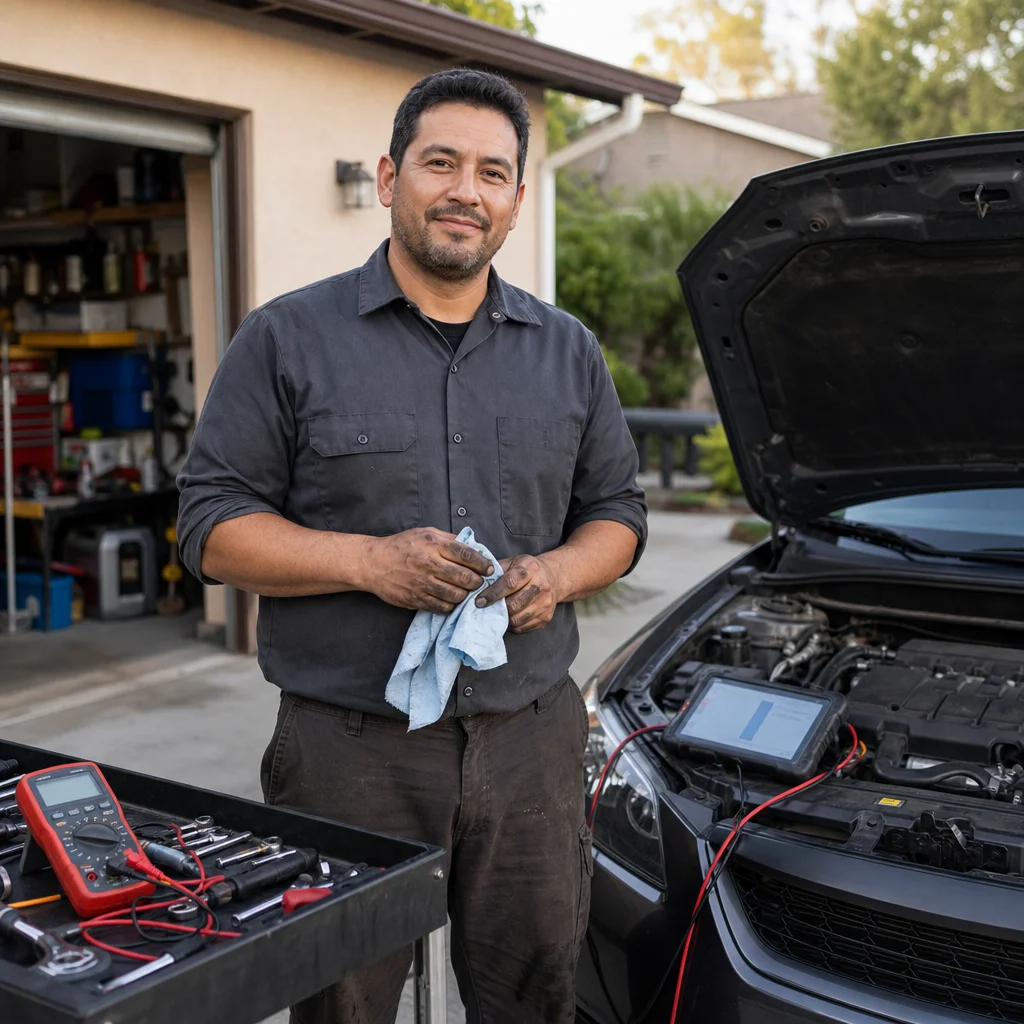
A clicking or popping noise during a turn is useful evidence, but it doesn’t identify one part by itself. The sound’s rhythm, location, timing, and relationship to acceleration can narrow the possibilities considerably. A repetitive click on tight turns points in a different direction than a single clunk, a wheel bearing hum, or a tire rubbing inside the wheel well.
Start by noticing exactly when the noise occurs. Does it happen only at low speed? Is the steering near full lock? Does it get louder when you accelerate? Can you hear it with the vehicle stopped while turning the steering wheel? These details often matter more than the word “clicking.”
The most common cause: an outer CV joint
A worn outer constant-velocity, or CV, joint is the classic cause of a repeated clicking or popping sound while turning, especially in a front-wheel-drive vehicle. It usually becomes most noticeable during a tight, slow turn while you’re applying light power. Turning left can make the right outer joint more noticeable, and turning right can load the left one, although noise can travel through the drivetrain and make location misleading.
The sound often follows vehicle speed: click-click-click as the wheel rotates, with the repetition becoming faster as you move faster. A tight turn in a parking lot may reveal it more clearly than an ordinary corner. Reversing in a circle can sometimes make a worn joint especially obvious, but don’t use aggressive acceleration or sharp maneuvers to reproduce the noise.
CV joints are protected by rubber boots packed with grease. If a boot tears, grease can be thrown onto the inside of the wheel or suspension, allowing dirt and moisture into the joint. Look through the wheel, if possible, for a split boot or streaks of thick grease. A damaged boot doesn’t always mean the joint has already failed, but continued driving can turn a relatively contained problem into a complete axle replacement.
An inner CV joint more commonly causes vibration or a clunk during acceleration and deceleration than a clicking sound on turns. That distinction isn’t absolute, but it helps keep the diagnosis focused. On some four-wheel-drive and all-wheel-drive vehicles, other axle or driveshaft joints can create similar noises.
Other causes that can sound like a CV joint
Tire or plastic liner contact
A tire can click, scrape, or slap against a wheel-well liner, mud flap, splash shield, or suspension component when the steering is turned. This may happen after installing different-size tires, changing wheel offset, carrying a heavy load, or damaging a plastic liner. The sound may be more of a rub or rhythmic slap than a sharp metallic click.
Inspect the tire sidewall and tread for fresh scuff marks. Check for loose plastic, a hanging underbody panel, or an inner fender liner that has pulled away from its fasteners. Don’t put your hands near the tire while anyone is turning the steering wheel, and don’t crawl under a vehicle supported only by a jack.
Tire contact deserves prompt attention even when the noise seems minor. Repeated rubbing can damage the tire, and contact may become worse when the suspension compresses over a bump or when the steering reaches full lock.
Loose wheel fasteners or a wheel problem
Loose lug nuts can produce clicking, ticking, clunking, or wobbling noises, and the consequences can be serious. A wheel that isn’t properly secured may move against the hub and can eventually separate from the vehicle. The noise may change during turns because cornering shifts the load through the wheel and hub.
If the noise began after a wheel change, tire service, brake work, or suspension repair, treat the timing as important. Park safely and check the lug nuts with the correct torque wrench if you know the vehicle’s specified torque. A visual check alone can't confirm that they’re tight enough. If a lug nut is missing, several seem loose, or the wheel is visibly out of position, avoid driving and arrange for professional help.
Wheel damage, a bent rim, or a tire with an internal problem can also create sounds that vary with speed and steering angle. A tire shop or repair facility can check for wheel runout, tire damage, and proper mounting.
Brake hardware or debris
A small stone caught between the brake rotor and dust shield can create a light metallic scraping or clicking sound. A bent dust shield may touch the rotor intermittently, particularly when the wheel or suspension shifts during a turn. Loose brake hardware can produce a rattle or click, sometimes accompanied by a change when you apply the brake pedal.
Don’t confuse a normal brake-system sound with a new, persistent noise. A clicking sound that changes when braking, a grinding sound, a hot or burning wheel, or a vehicle that pulls while braking calls for prompt inspection. Brake components can become extremely hot, so allow them to cool before looking near the wheel.
Wheel bearing, ball joint, tie-rod, or suspension wear
A failing wheel bearing more often produces a humming, growling, or rumbling sound that changes as the vehicle turns. The noise may become louder when the bearing is loaded in one direction and quieter in the other. Some damaged bearings can click or produce a rough sound, but a pure, repetitive clicking on a tight turn is more characteristic of a CV joint.
Worn ball joints, tie-rod ends, control-arm bushings, or strut mounts may cause a clunk or knock when you turn, brake, accelerate, or cross uneven pavement. A ball joint or steering connection is a safety-critical part. If you notice loose steering, wandering, uneven tire wear, a steering wheel that no longer returns normally, or a single heavy clunk, don’t rely on a noise-based diagnosis alone.
A strut mount can creak, pop, or groan when the steering wheel is turned, sometimes even while the vehicle is stationary. Because the sound may come from the top of the suspension rather than the wheel itself, it can be difficult to locate without a proper inspection.
Before driving farther: Stop and arrange an inspection if the clicking is accompanied by steering looseness, vibration, pulling, a wobbling wheel, rapid tire damage, grinding, a missing or loose lug nut, or any warning that the vehicle’s control has changed. If the vehicle feels normal but the noise is new, keep speeds and trips limited until you can identify it.
A safe way to narrow down the noise
Begin with a simple road observation in an empty, low-speed area. With the windows open, make a gentle left turn, then a gentle right turn. Notice whether the noise appears only near full steering lock or throughout the turn. Repeat at a slightly different speed without accelerating hard. A noise that becomes faster with wheel speed and louder under power supports a CV-joint diagnosis.
Next, drive straight at a safe speed and listen for sounds that don’t depend on steering angle. A steady hum that rises with road speed suggests a different group of possibilities, including tires or wheel bearings. A vibration that appears mainly during acceleration points more toward a driveline or inner-joint issue. A noise tied to bumps or braking points toward suspension or brake components.
If the sound occurs while the vehicle is stationary, turn the steering wheel only as needed and listen from inside the cabin. Avoid holding the steering at full lock, since some power-steering systems can strain in that position. A stationary pop may come from a strut mount, steering linkage, tire contact, or another component rather than an outer CV joint.
With the vehicle parked on level ground, inspect what you can see without removing parts. Look for torn CV boots, grease splatter, tire scuffs, loose wheel-well plastic, a bent brake dust shield, and obvious tire or wheel damage. Check whether the noise began after recent work or an impact, such as hitting a pothole or curb. That history can be more informative than trying to identify the sound from memory.
What repair might involve
A CV joint may be serviced separately on some vehicles, but replacing the complete axle assembly is common because it provides a new joint and boot together. The appropriate choice depends on the vehicle, part quality, labor cost, and condition of the other joint. A torn boot with no joint damage may sometimes be repaired early, while a joint that already clicks generally needs more extensive work.
A loose liner, bent dust shield, or trapped debris may be a relatively simple correction. Wheel fasteners require the vehicle manufacturer’s specified tightening procedure, usually with a calibrated torque wrench. Brake, steering, bearing, and suspension repairs require more caution because an incorrect installation can affect vehicle control.
Avoid replacing the most famous suspected part without confirming the symptoms. A CV axle won’t solve a loose wheel, damaged tire, or worn steering joint. When you take the vehicle to a shop, describe the conditions precisely: “repetitive clicking on slow right turns under light acceleration” is more useful than “it makes a noise when I turn.”
The sensible next step
A repetitive click during tight, powered turns makes an outer CV joint a strong possibility, but inspection should also cover the tire, wheel hardware, brakes, and steering or suspension components. If the sound is mild and the vehicle drives normally, document when it occurs and schedule a diagnosis rather than ignoring it. If there’s any change in steering, braking, wheel stability, or tire condition, stop driving and have the vehicle checked promptly.
The goal isn’t to name the part from the driver’s seat. It’s to use the pattern of the noise to make a safer decision, then confirm the cause before buying parts or continuing to drive.