Checking a Used Hybrid Before You Pay for a Pre-Purchase Inspection
A quick driveway check can reveal obvious hybrid trouble, but it can't replace specialist testing. I’ll show you how to assess warning lights, charging, cooling, brakes, records, and inspection priorities before you spend money on a professional evaluation.
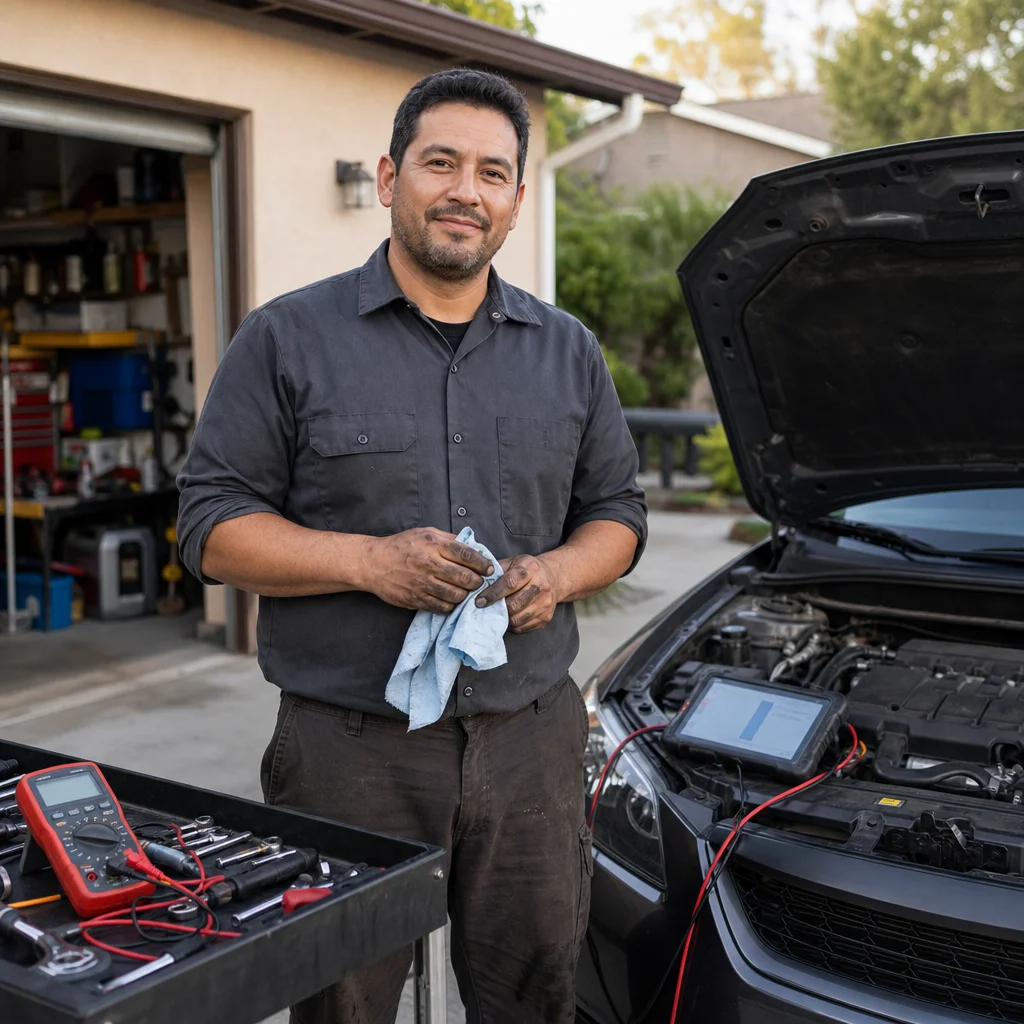
A used hybrid deserves more than a normal used-car walk-around, but you don’t need to pay for a full inspection before checking the obvious risks yourself. A short preliminary check can help you decide whether the car is worth taking to a hybrid-qualified technician—or whether you should walk away first.
The trade-off is important: your inspection can identify warning signs and poor maintenance, while professional testing can evaluate systems you shouldn't open or diagnose casually. Hybrid battery condition, high-voltage isolation, inverter operation, and manufacturer-specific faults may require equipment and training beyond a basic scan tool.
Start with the car switched off
Look over the vehicle before starting it. Check for mismatched paint, uneven panel gaps, flood residue, corrosion, damaged wiring, and signs of collision repair. These clues matter on any used car, but water or accident damage can create electrical problems that are difficult to trace later.
Inspect the underside if the seller allows it. You’re looking for fresh fluid leaks, bent battery or exhaust components, damaged plastic shields, and severe rust. A small amount of surface corrosion isn't automatically a problem, especially in regions that use road salt. Structural rust, crushed components, or wetness around electrical equipment deserve more caution.
Check the 12-volt battery as well. Hybrids still use a conventional low-voltage battery to operate computers, relays, lights, locks, and other systems. A weak 12-volt battery can cause confusing warning messages or starting problems, so don’t assume every dashboard symptom points to the expensive hybrid battery.
Open the engine compartment without touching orange high-voltage cables or exposed electrical components. Look for neglected fluid levels, rodent damage, loose connectors, cracked belts where applicable, and evidence of overheating. Your owner’s manual can show which reservoirs are intended for routine checking.
Watch the warning lights during startup
Ask the seller not to start the car before you arrive. A cold start gives you more useful information than walking up to a vehicle that has already been warmed up or recently cleared of diagnostic codes.
When you switch the car on, several warning lights should appear briefly as part of the self-check and then go out after the vehicle starts. Pay attention to the hybrid system, check-engine, battery, ABS, brake, airbag, and temperature warnings. A light that remains illuminated, flashes, or returns during the drive is a reason to pause the purchase process.
A dashboard that looks normal doesn't prove that the vehicle is healthy. Fault codes can be cleared, and some problems return only after the car completes specific driving conditions. Ask whether the 12-volt battery was recently disconnected or replaced, and be cautious if the seller can't explain why readiness monitors are incomplete.
A basic OBD-II scanner may reveal useful engine and emissions information, but inexpensive scanners don’t always access manufacturer-specific hybrid, battery, braking, or body modules. Even when a code is available, its presence usually identifies a system to investigate rather than naming the failed part with certainty.
Confirm the hybrid coverage: Before relying on the seller’s description of the battery or hybrid-system warranty, check the vehicle identification number with the manufacturer or an authorized dealer. Coverage, transfer rules, time limits, mileage limits, and regional requirements can vary by model year and location.
Observe how the hybrid starts and drives
With your foot firmly on the brake, start the vehicle and listen. Many hybrids begin quietly on electric power, so the absence of an engine-start sound isn't itself a concern. You should still notice whether the vehicle starts smoothly, displays unusual messages, or takes an unexpectedly long time to become ready.
During the first few minutes, the gasoline engine may start and stop several times. That can be normal as the vehicle warms up, charges the battery, controls cabin temperature, or responds to the accelerator. What matters more is whether the transitions feel excessively harsh, produce unusual noise, or coincide with warning lights.
Drive at low speed in a safe area, then include ordinary streets and, if permitted, a short faster section. The vehicle should accelerate predictably without a sudden loss of power. Pay attention to surging, hesitation, a whining sound that changes abnormally with speed, or a message indicating reduced power. A hybrid’s regenerative braking can feel different from a conventional car, but the pedal should still be consistent and controllable.
When you lift off the accelerator, you may feel the car slow as energy is recovered. That regenerative effect often changes as the battery fills, the battery is cold, or the brake system blends regenerative and friction braking. It shouldn't be confused with a brake pedal that pulses, sinks, pulls to one side, or feels weak. Those symptoms need attention before you consider buying.
Check charging behavior and battery cooling
For a conventional hybrid, observe the energy display during acceleration, cruising, and deceleration. The battery gauge commonly moves within a middle range rather than staying full or empty. Rapid swings, persistent low charge, repeated engine operation under light loads, or a warning message can justify professional testing, although the display alone can't determine battery health.
For a plug-in hybrid, ask to see the charging equipment and confirm that the vehicle can accept a charge if the seller has permission to demonstrate it safely. Inspect the charge port for bent pins, corrosion, moisture, or damage. Don’t use an unfamiliar extension cord or improvised connection just to perform a test; follow the vehicle and charging-equipment instructions.
Find the battery cooling intake, usually located inside the passenger compartment or cargo area, and make sure it isn’t blocked by luggage, pet hair, dust, or aftermarket covers. Don’t spray cleaner into the vent or remove trim to reach the battery. A restricted intake can contribute to overheating, but a clean-looking vent doesn't confirm the condition of the battery itself.
Listen for cooling fans during or after a drive. Fan operation can be normal, especially in warm weather or after demanding driving. A fan that is constantly loud, accompanied by a battery warning, or followed by reduced performance is more significant and should be assessed by a qualified technician.
Review service history instead of relying on mileage
Mileage is only one part of a hybrid’s condition. Look for regular oil changes, coolant service where specified, brake inspections, tire replacement, 12-volt battery work, and any documented hybrid or battery repairs. Plug-in models may also have charging-system or cable-related records.
Service intervals differ among manufacturers and model years. Don’t assume that a hybrid’s gasoline engine never needs oil changes, or that regenerative braking means the friction brakes can be ignored. Brake fluid can absorb moisture, tires still wear normally, and coolant circuits may have separate requirements.
Compare the records with the car’s mileage, title history, inspection paperwork, and reported ownership. Long gaps aren't automatic proof of failure, but they reduce your confidence and make a professional inspection more valuable. Be wary of records that show repeated unresolved warning lights, unexplained gaps, or major work without supporting invoices.
You can also check the vehicle identification number for title brands, open recalls, and available manufacturer service information through appropriate official or government sources. A recall remedy may be available at no charge, but that doesn't mean every related symptom is covered or that a used vehicle has been maintained properly.
Check today’s records and coverage: Use the vehicle identification number to review current recall information, title history, and any manufacturer warranty details through authoritative sources. Treat a seller’s verbal assurance as a starting point, not as documentation.
Decide what requires specialist testing
Pay for a hybrid-qualified inspection when the car otherwise looks promising but you can't verify the expensive or safety-critical systems. Ask the shop whether it can access hybrid control modules, evaluate battery data under load, inspect high-voltage safety systems, and diagnose regenerative braking. A general inspection that checks only fluids, tires, and engine codes may not answer the questions that matter most.
A professional should also be able to distinguish a weak 12-volt battery from a high-voltage battery problem and identify whether a warning relates to the battery, inverter, cooling system, wiring, or another control module. Ask what the inspection includes before authorizing it. “Hybrid inspection” can mean different things from one shop to another.
Don’t attempt to remove a hybrid battery cover, disconnect orange cables, probe high-voltage terminals, or perform resistance tests without the required training and equipment. The vehicle can contain dangerous voltage even when the engine is off. Leave high-voltage diagnosis, battery opening, and isolation-fault investigation to a properly equipped professional.
The preliminary check is most valuable as a decision filter. Walk away, or renegotiate your plans, when you find active warning lights, serious rust or flood evidence, poor brake performance, damaged charging equipment, missing ownership records, or a seller who refuses a reasonable inspection. A low purchase price rarely compensates for an unknown safety or hybrid-system fault.
If the car passes your basic checks, schedule the professional inspection before finalizing the purchase whenever the seller and transaction allow it. Bring the service records and your notes, and tell the technician exactly what you observed. That gives the inspection a useful starting point rather than asking it to discover every possible issue without context.
Your goal isn’t to certify a used hybrid in a driveway. It’s to identify obvious reasons not to proceed, understand which risks remain uncertain, and spend inspection money on a vehicle that has earned a closer look. That balance gives you better information without pretending that a basic check can replace specialist testing.