How to Diagnose a Starter That Spins but Doesn't Engage
I’ll explain why a starter motor can spin without turning the engine, how to separate solenoid, drive-gear, ring-gear, and battery faults, and which tests make sense before replacing parts.
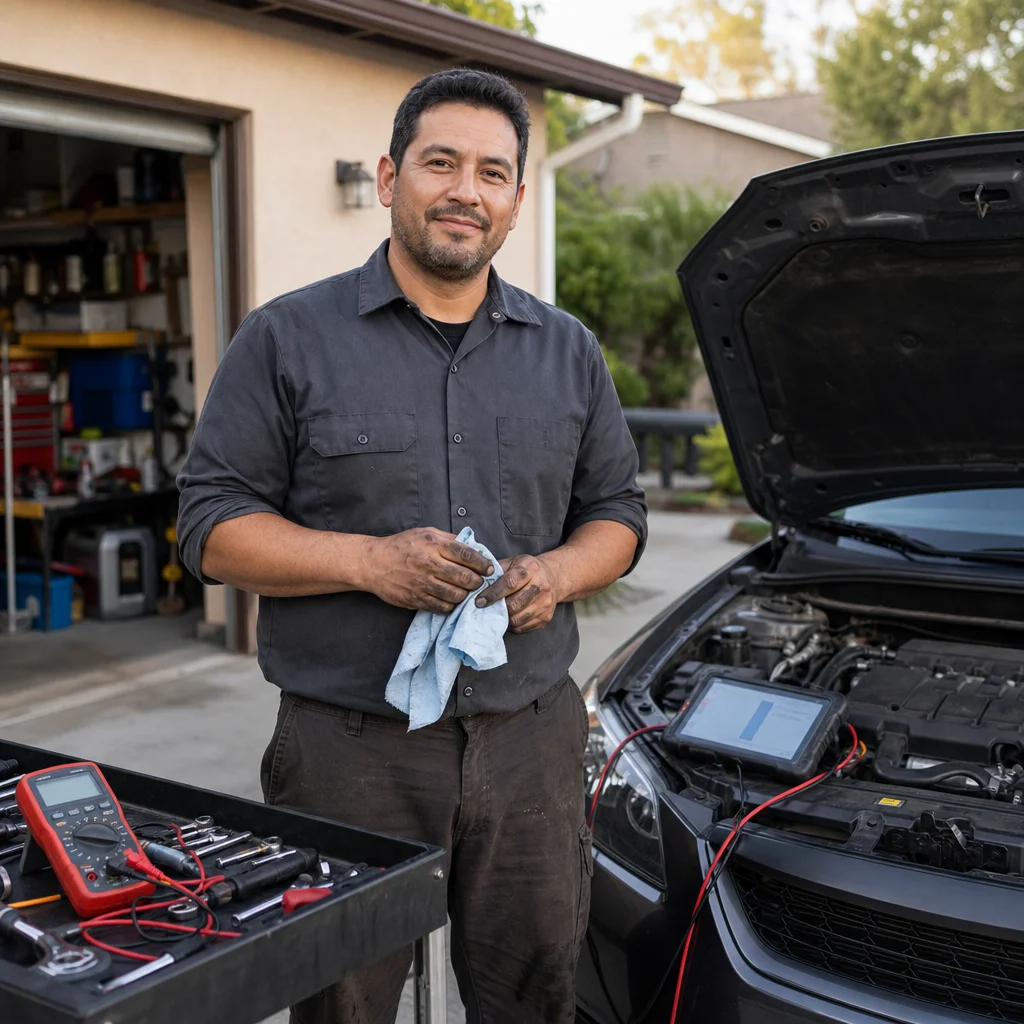
The sound can be misleading: a starter that whirs loudly may be receiving power while its drive gear never reaches the engine’s flywheel or flexplate. That is different from a starter that turns the engine slowly, clicks, or fails to turn at all.
The useful question isn't simply whether the starter motor spins. You need to determine whether the starter’s pinion gear extends and locks into the ring gear, and whether the engine then turns with it. Once those actions are separated, the likely fault becomes much easier to narrow down.
Set up a safe engagement test
Put the transmission in Park or Neutral, apply the parking brake, and keep clear of belts, fans, and pulleys. Disable ignition or fuel delivery before testing starter operation when you need to prevent the engine from starting. Follow the vehicle’s service information if it uses a start-stop system, hybrid equipment, or unusual starter controls.
What “spins but doesn't engage” means
A conventional starter has two related but separate functions. The electric motor provides rotation, while a solenoid and mechanical drive assembly move the small pinion gear into the ring gear around the engine’s flywheel or flexplate. The pinion’s overrunning clutch then transfers torque in the cranking direction while protecting the starter after the engine starts.
When you hear a fast, smooth whirring sound but the engine doesn't move, the motor may be rotating without carrying the pinion into the ring gear. The pinion might remain retracted, or it might extend without properly locking and transmitting torque. In either case, the starter can sound active even though the crankshaft is stationary.
That differs from a slow-crank condition. With a weak battery, poor cable connection, or a worn motor, the starter usually turns slowly, labors, or produces repeated clicks. Battery problems can still contribute to an engagement fault, especially when voltage falls too far for the solenoid to complete its travel, but a strong free-spinning whine points more directly toward the engagement mechanism.
The main parts involved
Solenoid and engagement mechanism
On many starters, the solenoid does more than act as a remote electrical switch. Its plunger moves a lever or fork that pushes the pinion toward the ring gear. The solenoid may also close high-current contacts that power the motor.
A failure in one part of that sequence can produce a confusing result. The high-current contacts may feed the motor while a damaged plunger, shift fork, return spring, or internal connection prevents the pinion from extending. Some starter designs use separate electrical windings or switching stages, so the motor can appear to operate even when the mechanical engagement action is incomplete.
A solenoid that clicks but doesn't move the gear may have weak windings, excessive resistance in the control circuit, worn internal contacts, or mechanical binding. A solenoid that is mechanically stuck can leave the drive retracted. On an integrated starter, replacing the complete unit is often more practical than rebuilding the individual mechanism, but the design should be confirmed before buying parts.
Pinion drive and overrunning clutch
The pinion drive, sometimes called a Bendix drive or starter drive, is the moving gear assembly at the starter’s nose. It has to slide or be thrown forward and then transmit torque. Dirt, corrosion, damaged splines, a weak spring, or a worn drive can stop it from traveling correctly.
The overrunning clutch can also fail. If the pinion extends but the clutch slips, the starter may produce a whirring or high-speed sound while the engine remains still. This is different from a pinion that never reaches the ring gear, but the symptoms can overlap because both faults leave the engine uncranked.
Don't assume that a visibly undamaged gear is healthy. The teeth may look acceptable while the clutch slips under load, or the drive may bind on its shaft. A bench test that only proves the motor spins isn't enough; the drive must extend and hold torque in the correct direction.
Flywheel or flexplate ring gear
The ring gear is the large toothed gear that the starter pinion engages. On some vehicles it is mounted on the flywheel; on automatic-transmission vehicles it is commonly part of the flexplate assembly. A section of missing, rounded, or damaged teeth can allow the starter to engage in one crankshaft position but spin freely in another.
A ring-gear fault often produces an intermittent symptom. The vehicle may start normally several times and then free-spin when the engine stops with the damaged section aligned with the starter. If rotating the engine slightly by hand makes the starter work temporarily, inspect the ring gear rather than treating the starter as the only suspect.
A ring gear can also be loose, cracked, or improperly positioned after engine or flexplate work. Incorrect starter alignment, missing locating dowels, wrong mounting hardware, or an incorrect replacement starter can prevent the gears from meeting correctly. Grinding during cranking is an important warning sign because continued operation can damage both gears.
A sensible diagnostic sequence
1. Confirm what is actually moving
Listen while observing the engine safely from a suitable position, or use a helper while you control the test. If the starter whines and the crankshaft pulley doesn't rotate, the starter isn't transmitting torque to the engine. If the pulley rotates but the engine still won't start, you have a separate fuel, ignition, compression, or engine-control problem rather than a starter-engagement problem.
Don't rely on sound alone. A starter can make a harsh grinding noise when the pinion partly engages, while a slipping overrunning clutch can sound like a clean electric motor. The distinction matters because replacing the battery won't repair a damaged drive or ring gear.
2. Check battery condition and connections
Inspect the battery terminals, engine ground, and positive cable at the starter. Look for looseness, corrosion under the cable end, damaged insulation, or a cable that becomes unusually warm during a start attempt. A battery can show acceptable open-circuit voltage and still collapse under load, so a load test or voltage measurement during cranking is more useful than voltage alone.
A weak battery is more likely to cause slow cranking or clicking, but it should still be eliminated before condemning the starter. Low voltage can reduce solenoid travel, particularly where the control circuit has additional resistance from a worn relay, ignition switch, neutral-safety switch, connector, or ground.
3. Test the control side and solenoid feed
Use the vehicle wiring diagram to identify the starter’s control terminal and main battery terminal. During a start request, the control terminal should receive the specified voltage, and the main terminal should remain capable of supplying high current. Exact readings and test points vary by vehicle, so don't apply a generic terminal-jumper procedure to a system with electronic start authorization.
If the control signal is missing, investigate the start relay, clutch or neutral-position switch, immobilizer system, wiring, and engine-control authorization. If the control signal is present but the starter only free-spins, the problem becomes more likely to be inside the solenoid, drive assembly, or starter mounting arrangement.
4. Inspect the starter and drive gear
Remove the starter when the electrical checks point to it, following the manufacturer’s battery-disconnection and access procedures. Inspect the pinion for chipped or heavily worn teeth and check whether the drive moves smoothly as designed. Some drives aren't meant to be forced by hand, so use the service instructions rather than applying excessive pressure.
A proper bench test should check more than motor rotation. The drive should extend fully, remain engaged while the motor applies torque, and retract when power is removed. A parts store’s basic test may not reproduce the exact load or engagement geometry, so a passing motor-only test doesn't always clear the starter drive.
5. Inspect the ring gear through several positions
If the starter appears functional, inspect the ring gear through the starter opening or another access point. Rotate the engine by hand only with the proper procedure and tools, keeping the ignition disabled. Examine more than one section of the ring gear because damage may be limited to the position where the engine usually stops.
Look for missing teeth, flattened tooth faces, cracks, looseness, or evidence that the starter has been contacting the gear at an angle. If the starter works after the engine is rotated slightly, that is strong evidence of localized ring-gear damage. Repair may require flywheel or flexplate replacement, which is substantially more involved than changing a starter.
Common diagnostic mistakes
The most common mistake is replacing the battery because the symptom is described as “the starter won’t catch.” Battery condition matters, but a battery normally can't restore missing teeth, a failed overrunning clutch, or a broken engagement fork. Test voltage and connections, then move to the mechanical parts when the motor clearly free-spins.
Another mistake is repeatedly trying to start the vehicle through a grinding sound. Each attempt can worsen damage to the pinion and ring gear. If engagement is intermittent, stop after confirming the pattern and inspect the starter and ring gear rather than treating the successful attempts as proof that the system is acceptable.
It is also easy to install the wrong starter or overlook alignment hardware after an engine, transmission, or flexplate repair. Compare the replacement unit’s pinion, mounting surfaces, terminal arrangement, and part number with the original and the vehicle application. Don't add or remove shims unless the manufacturer’s procedure calls for them; incorrect spacing can create both free-spinning and grinding symptoms.
When the repair is beyond a basic starter replacement
Replacing an accessible starter is often within an experienced DIYer’s abilities, but ring-gear damage usually requires much more disassembly. A starter mounted near hot exhaust components, under a vehicle with limited support points, or on a system with high-voltage hybrid components also raises the risk. Electronic start authorization and integrated starter-generator systems may not behave like a conventional starter circuit.
If the engine must be rotated manually, the starter must be shimmed according to a specific clearance, or the flexplate appears damaged, use the factory procedure or obtain professional help. The cost of a diagnosis is usually smaller than the cost of damaging a replacement starter, ring gear, wiring harness, or vehicle control module.
A starter that spins without turning the engine is telling you that motor rotation and mechanical engagement are no longer happening together. Start by confirming that the crankshaft is stationary, rule out battery and cable weakness, then test the solenoid and inspect the drive. If those parts work, examine the ring gear in several positions and consider alignment or recent repair history. That sequence keeps you from replacing good electrical parts when the real fault is mechanical.ไทยฟรี