How to Use Pending Codes Without Replacing Parts Too Soon
I’ll explain how pending OBD codes differ from confirmed faults, how drive cycles affect scan results, and what evidence to collect before buying parts. You’ll learn when to monitor the vehicle, test further, or seek professional diagnosis.
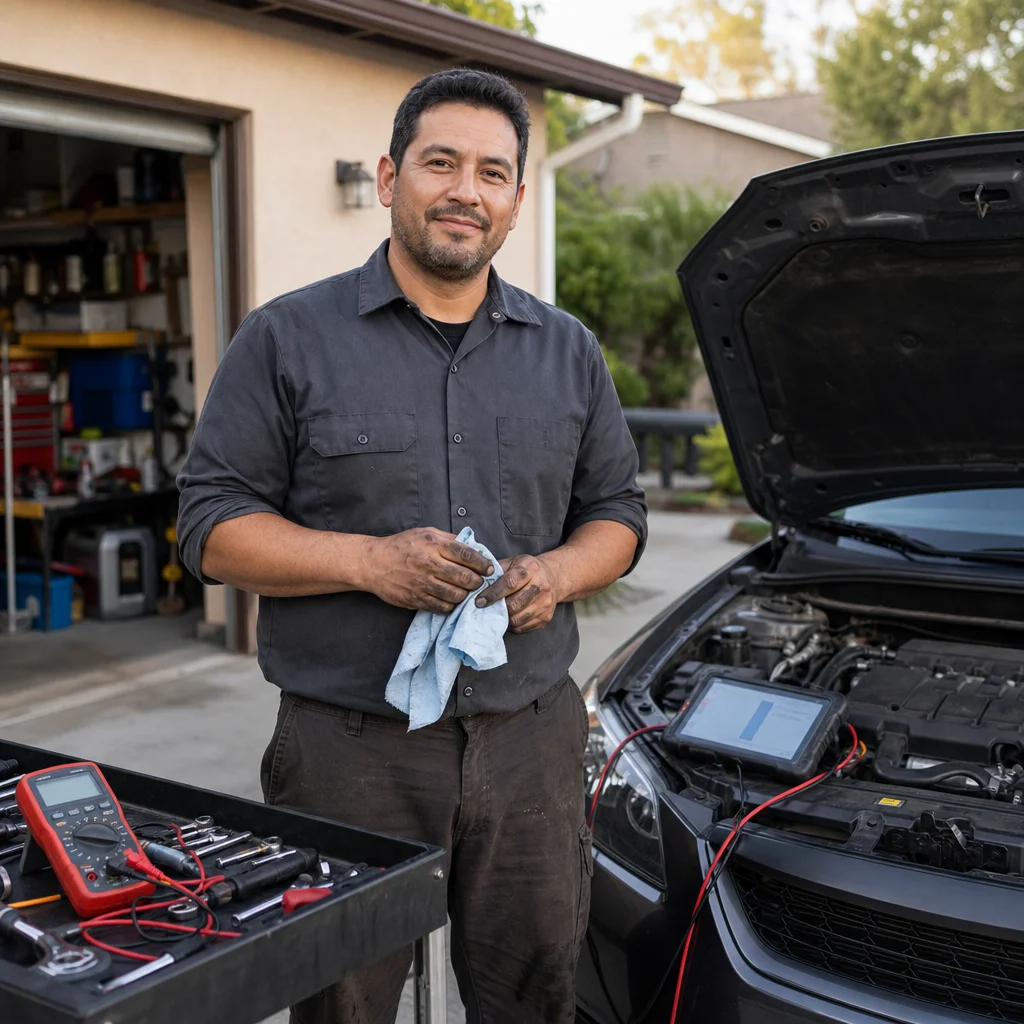
A pending diagnostic trouble code can be useful evidence without being proof that a component has failed. If your scan tool shows a code but the check-engine light is off—or a code appears alongside no obvious symptoms—the safest response is usually to gather more information before replacing anything.
Pending codes are especially helpful for catching an intermittent problem early. They can also appear after a temporary condition, a loose connection, or a test that hasn't yet failed often enough for the vehicle’s computer to treat it as confirmed. Understanding that distinction helps you avoid turning a diagnostic clue into an unnecessary parts bill.
What a pending code means
Your vehicle’s engine and emissions computer continually runs self-tests called monitors. These tests look at systems such as fuel mixture, ignition misfires, oxygen-sensor operation, evaporative-emissions leaks, and catalytic-converter performance. The exact tests and criteria vary by vehicle, but the basic idea is the same: the computer compares sensor information with expected operating ranges.
A pending code generally means one of those tests detected an abnormal result, but the fault hasn't yet met the conditions required for a confirmed code. A single unusual reading may be enough to create a pending code. The computer may need the same problem to occur again under similar conditions before it stores a confirmed code and turns on the malfunction indicator lamp.
That doesn't make a pending code meaningless. It tells you that the vehicle noticed something worth investigating. It also doesn't identify a failed part with certainty. A code that mentions an oxygen sensor, for example, may result from an exhaust leak, wiring problem, air leak, fuel-delivery issue, or sensor that is actually aging.
Some vehicles use different labels, including “pending,” “temporary,” “one-trip,” or “test failed.” Your scan tool may also show manufacturer-specific status information. If the wording is unclear, consult the vehicle service information or the scan tool’s documentation rather than assuming every label has the same meaning.
Pending versus confirmed codes
A confirmed or stored code usually means the computer has detected the fault according to its longer-term criteria. In many cases, the check-engine light will turn on when the fault becomes confirmed. The light may remain on even if the problem isn't occurring at that exact moment, because the computer records the earlier failure.
A pending code can be present before that point. It may disappear if later tests pass, or it may become confirmed if the fault repeats. The transition depends on the vehicle, the specific monitor, and the conditions needed for that monitor to run. There is no universal number of trips or miles that applies to every code.
A pending code and a confirmed code can also coexist. For example, a vehicle may have a confirmed misfire code from an earlier event and a pending fuel-trim code from a more recent condition. Treat each code as part of the same diagnostic story until you understand when and how each one appeared.
The check-engine light adds another important clue. A steady light generally indicates that the computer has detected a problem that needs attention, but it doesn't always mean the car must be stopped immediately. A flashing light commonly indicates an active or severe misfire that can damage the catalytic converter. That situation deserves a more urgent response than an isolated pending code with normal vehicle behavior.
Check the light before continuing: If the check-engine light is flashing, the engine is shaking, power has dropped sharply, or you smell fuel or burning material, reduce driving and arrange qualified help. Don't treat a pending-code situation as routine when the vehicle is running dangerously or worsening quickly.
How drive cycles affect what you see
A drive cycle is a period of vehicle operation that allows one or more self-tests to run. It isn't simply a fixed distance. The computer may need a cold start, a particular coolant temperature, steady cruising, periods of acceleration or deceleration, or enough time at certain speeds. An evaporative-emissions test may require conditions that are different from those used for a misfire or oxygen-sensor test.
Because of these requirements, a fault may remain pending for several trips without becoming confirmed. A short commute mightn't provide the conditions needed for a monitor to complete. Conversely, a problem that occurs only after the engine warms up may not appear during a brief cold-start check.
If you recently disconnected the battery or cleared codes, the computer may also show that monitors are incomplete. This is different from a clean bill of health. Clearing codes erases stored diagnostic information and resets monitor results; it doesn't repair the underlying issue. The vehicle then needs suitable driving conditions before its monitors can run again.
You don't need to force a complicated driving routine just to make a pending code change status. Drive normally and safely, paying attention to when the code appears and how the vehicle behaves. Aggressively trying to reproduce a fault can create unsafe conditions and may make the evidence harder to interpret.
What to record before replacing parts
Start by saving the exact code, its status, and the date or mileage. If your scanner can display freeze-frame data, save that too. Freeze-frame information may show engine speed, coolant temperature, vehicle speed, fuel-trim values, throttle position, or other readings from the moment a confirmed fault was recorded. Pending codes don't always have freeze-frame data, but it is worth checking.
Record whether the check-engine light is off, steady, or flashing. Note the circumstances around the event: cold start or warm engine, highway or city driving, wet weather, fuel fill-up, heavy load, hard acceleration, idling, or a recent repair. A fault that appears only after refueling points toward a different line of investigation than one that occurs during a long uphill pull.
Look for related codes and live-data patterns rather than focusing on one component name. Misfire codes, fuel-trim codes, oxygen-sensor codes, and evaporative-emissions codes may be connected. A scan tool showing several unrelated codes after a weak battery or poor electrical connection may call for basic voltage and connection checks before expensive component testing.
Inspect simple causes without disturbing anything unnecessarily. Check that the fuel cap is properly installed, look for disconnected intake hoses, examine accessible wiring for damage, and confirm that recent work didn't leave a connector loose. Don't unplug sensors or open fuel-system components while the engine is hot or when fuel vapors could ignite.
A sensible decision process
If a pending code appears once and the vehicle runs normally, save the information and monitor it through normal driving. Avoid clearing the code immediately, because doing so removes a useful starting point. If the code disappears and doesn't return, the event may have been intermittent, but you should still pay attention if the same symptoms recur.
If the code returns under the same conditions, treat that repetition as stronger evidence. Compare the current data with the earlier record. Check for a confirmed code, additional codes, changes in fuel economy, rough running, hard starting, unusual smells, or reduced power. At that stage, targeted testing is more useful than replacing the part named in the code.
For a beginner, targeted testing may mean checking a connector, inspecting a vacuum hose, measuring battery voltage, reviewing live data, or following a service-manual test. The correct test depends on the code and vehicle. A code reader that only retrieves codes can't usually prove whether a sensor, wiring circuit, mechanical system, or computer is at fault.
A professional diagnosis becomes the sensible choice when the code involves an active misfire, drivability is deteriorating, the vehicle stalls, the problem affects braking or steering, fuel is leaking, or you lack the equipment to test the suspected circuit safely. It is also reasonable to seek help when several systems report faults at once or when the code repeatedly returns after basic checks.
Confirm the result before buying a part: Use the code as a direction for testing, not as a shopping list. Verify the circuit, wiring, power supply, grounds, mechanical condition, and related systems when the diagnostic procedure calls for them.
Common mistakes with pending codes
The most expensive mistake is replacing the named sensor immediately. Diagnostic codes describe a monitored fault, and their wording is often compressed. “Sensor circuit,” “range or performance,” and “system too lean” each point to different kinds of investigation. Even a genuine sensor failure may be caused by contamination, a damaged harness, or another problem that will damage the replacement.
Another mistake is clearing the code before saving the evidence. After a reset, you may lose freeze-frame data, erase useful status information, and make it harder to tell whether the problem is improving. Clearing a code can be appropriate after repairs or during a structured diagnostic procedure, but it should be a deliberate step rather than the first response.
It is also easy to assume that no check-engine light means no problem exists. Pending codes, incomplete monitors, and intermittent faults can all occur without a steady light. On the other hand, an isolated pending code doesn't justify assuming that a serious failure is developing. The vehicle’s symptoms, warning-light behavior, repeated test results, and inspection findings should guide the decision together.
The practical takeaway
Treat a pending code as an early warning and a request for better evidence. Save the code and available data, note the driving conditions, check simple and safe possibilities, and allow normal driving to show whether the fault repeats. Don't erase the record just to make the scanner screen look clear, and don't replace a part solely because its name appears in the code description.
If the code becomes confirmed or the warning light turns on, continue with diagnosis rather than guessing. When the light flashes, the engine runs poorly, or the problem involves a safety-critical system, stop treating it as a wait-and-see issue. A careful diagnosis costs less than a chain of unnecessary parts—and gives you a better chance of fixing the actual cause.