How to Use a Compression Tester Without Drawing the Wrong Conclusion
I’ll clarify how to use a compression tester without mistaking one low reading for a failed engine. You’ll learn how battery condition, throttle position, repeatability, wet testing, and engine-specific specifications change what the numbers actually mean.
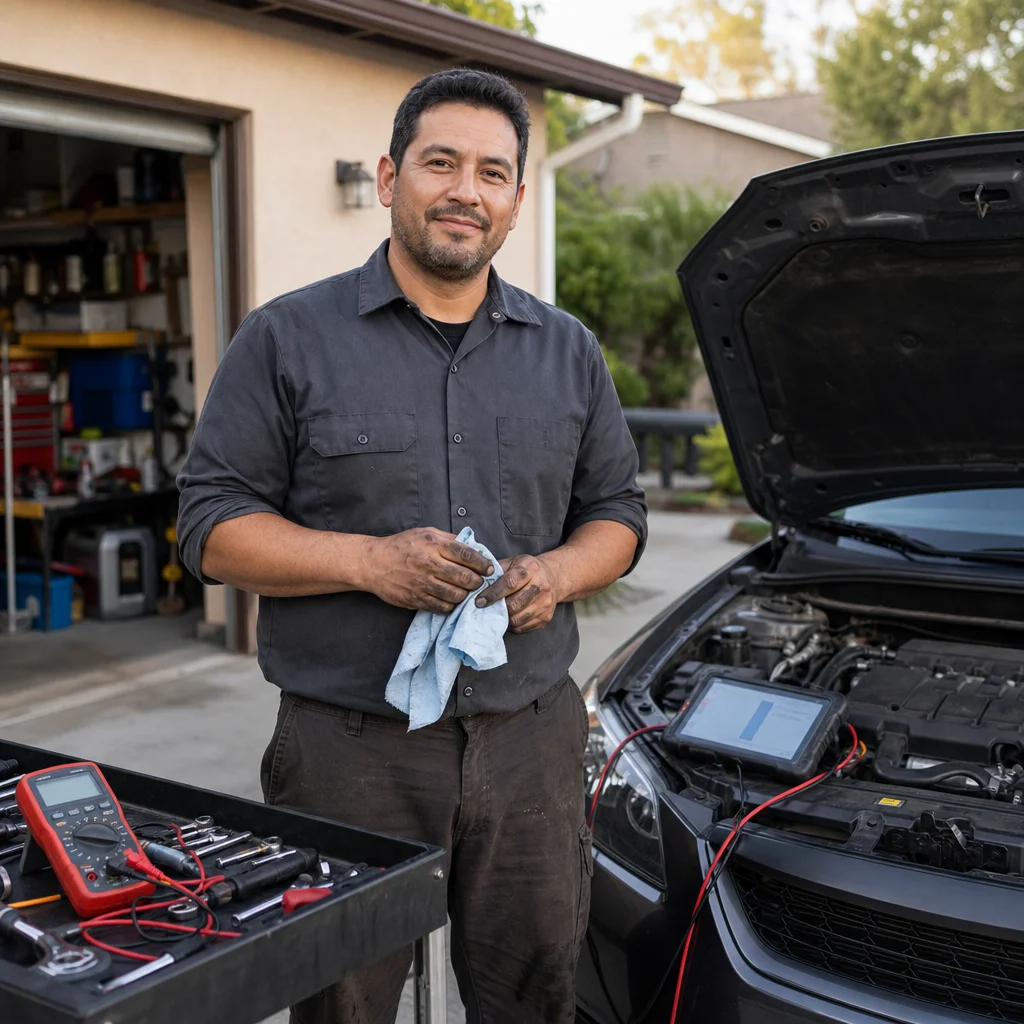
A compression tester can give you useful evidence about an engine’s mechanical condition, but the gauge reading isn't a verdict by itself. A low number may point to worn rings, a leaking valve, a head-gasket problem, incorrect test conditions, or simply a weak battery that can't spin the engine fast enough.
The goal is to make the test repeatable, compare cylinders fairly, and interpret the pattern rather than reacting to one number. The procedure below is aimed mainly at gasoline engines. Diesel engines use different equipment and precautions, so use the manufacturer’s procedure for those applications.
What a compression test can—and can't—tell you
During a compression test, the starter turns the engine while the tester records the pressure each cylinder can build. The result reflects several factors at once: the condition of the piston rings, valves, cylinder walls, head gasket, camshaft timing, starter speed, and the amount of air entering the cylinder.
That makes compression testing a screening tool rather than a complete diagnosis. It can show that one cylinder is substantially weaker than the others, or that all cylinders are low. It usually can't identify the exact failed component without additional testing.
The specification in the repair information for your engine matters more than a generic number found online. Engines differ in compression ratio, valve timing, camshaft design, and gauge procedure. Even when no factory specification is available, the relationship between cylinders is often more useful than an isolated maximum or minimum reading.
Check your engine’s test conditions: Before you interpret the gauge, confirm the recommended compression range, minimum allowable reading, cylinder-to-cylinder variation, and whether the manufacturer specifies a particular cranking procedure. Those details can differ between engines.
Prepare the engine and tester correctly
If possible, test the engine at normal operating temperature. Warm oil seals the piston rings more consistently than cold, thick oil, and a warm engine generally produces readings that are easier to compare with service specifications. If the engine doesn't run, you can still test it cold, but record that condition and avoid comparing the results directly with a warm-engine specification.
Park on a level surface, apply the parking brake, and keep the transmission in Park or Neutral. Keep clothing, tools, and wiring away from belts, pulleys, fans, and other moving parts. A compression test requires repeated cranking, so the battery needs to be charged and the starter needs to be in reasonably good condition.
You also need to prevent the engine from starting. On many gasoline vehicles, this means disabling both fuel delivery and ignition according to the service procedure. Removing a fuel-pump fuse or relay may stop fuel injection, but it doesn't necessarily disable ignition. Pulling ignition coils or disconnecting electrical components without knowing the circuit can create faults or damage components.
Follow the vehicle’s service information for the safest way to disable fuel and spark. If you must disconnect ignition coils, keep the disconnected connectors and high-voltage parts away from grounded metal as directed. Don't allow raw fuel to collect in the intake or cylinders.
Remove all spark plugs, not just the plug from the cylinder being tested. Leaving the other plugs installed makes the starter work against compression in the remaining cylinders and can slow cranking. Label coils, plug wires, and connectors if their positions aren't obvious.
Inspect the tester before connecting it. The hose must have the correct thread and sealing washer for the spark-plug hole, and the gauge’s release valve must function. A damaged hose, missing O-ring, or loose adapter can produce a false low reading.
Use the same test for every cylinder
With the plugs removed and the engine prevented from starting, install the tester by hand. It should engage the threads smoothly. Don't force a cross-threaded adapter into an aluminum cylinder head. Tighten it enough to seal; excessive force is unnecessary and can damage the plug threads.
Open the throttle during the test. On a traditional cable-operated throttle, press the accelerator fully. With electronic throttle control, the pedal may not open the throttle plate if the ignition is off, and the appropriate procedure varies. The important point is to provide the same, unrestricted intake condition for every cylinder. Follow the vehicle-specific method rather than assuming the pedal position always controls the plate.
Crank the engine for the same number of compression strokes for each cylinder—often several pulses, such as four to six, depending on the tester and service procedure. Watch the gauge as the pressure rises. Stop when the reading no longer increases meaningfully or when the specified number of revolutions is complete.
Write down the result immediately, then release the gauge pressure before moving to the next cylinder. Record the cylinder order, the engine temperature, and any unusual behavior. A written record prevents a vague impression such as “the middle cylinders looked low” from replacing useful evidence.
If the readings seem inconsistent, repeat the questionable cylinder and one neighboring cylinder. Don't change several conditions at once. For example, if you charge the battery, open the throttle, and replace the tester hose before retesting, you will know the result changed but not which correction mattered.
Why battery condition matters
The starter must spin the engine quickly enough for each cylinder to build pressure. As the battery becomes weak, cranking speed falls. A slow starter can make every cylinder read lower than expected, and the later cylinders may appear worse because the battery has lost additional charge during testing.
This is one of the easiest ways to draw the wrong conclusion. A set of uniformly low readings doesn't automatically mean the engine has worn rings or late valve timing. It may mean the test was performed with insufficient cranking speed.
Start with a fully charged battery. If the starter sounds slow, the battery voltage drops sharply during cranking, or the results decline from the first cylinder to the last, pause and correct the cranking-speed problem. A battery charger or a known-good battery can help, but use the charger according to its instructions and keep electrical connections secure.
A failing starter can also produce slow cranking even with a healthy battery. If the engine turns unevenly or much more slowly than normal, treat the compression numbers as questionable until the cranking problem is addressed.
Read the pattern before the number
A healthy engine commonly produces readings that are reasonably close across cylinders, but “close” must be judged against the manufacturer’s specification. Some service information gives a maximum cylinder-to-cylinder difference rather than a single acceptable pressure range. A common rule of thumb is that cylinders should remain within roughly 10 to 15 percent of the highest reading, but that is only a screening guideline—not a universal specification.
One cylinder that is substantially lower than the rest deserves attention. Two adjacent low cylinders can suggest a head-gasket sealing issue between those cylinders, although valve problems, cam timing, and other faults can create similar patterns. All cylinders low by a similar amount may point toward slow cranking, a throttle that wasn't open, incorrect valve timing, a worn engine, or an engine design that naturally produces lower gauge readings.
A higher-than-expected reading isn't automatically good news. Heavy carbon deposits can reduce combustion-chamber volume and raise the gauge reading. Oil in the cylinder can temporarily improve ring sealing and also increase the result. Compare the readings with symptoms such as hard starting, misfires, low power, oil consumption, or unusual exhaust smoke.
Repeatability matters. If the same cylinder reads low on two properly performed tests while the others remain consistent, the result is more meaningful than a single low reading obtained under uncertain conditions.
Use a wet test carefully
A wet compression test adds a small amount of engine oil to a low-reading cylinder before repeating the test. The oil can temporarily seal the gap between worn piston rings and the cylinder wall. If the reading rises noticeably, ring or cylinder-wall wear becomes more likely.
If the reading changes very little, the problem is more likely to involve a valve that isn't sealing, a damaged head gasket, incorrect valve timing, or another issue that oil can't temporarily seal. This is a useful direction, not proof of one specific failure.
Use only a small amount of oil. Too much can create an artificially high result and, in some situations, contribute to hydraulic lock or other damage. Keep the oil away from electrical connectors and ignition components, and follow the tester or service information for the recommended amount.
A wet test is less useful on engines with unusual cylinder designs, severe damage, or certain modern systems where the basic test procedure differs. If you are uncertain, a leak-down test is usually the better next step because it can help identify where compression is escaping.
When a leak-down test is the better next step
A compression test tells you how much pressure the cylinder builds while cranking. A leak-down test supplies compressed air to a cylinder held near top dead center and measures how much air escapes. Listening at the intake, exhaust, crankcase, and coolant reservoir can help narrow down the leakage path.
Air heard at the intake may indicate an intake-valve leak. Air from the exhaust suggests an exhaust-valve leak, while air heard through the oil-filler opening can point toward ring or cylinder-wall leakage. Bubbles in the coolant may indicate a head-gasket or cylinder-head problem, though the test setup and engine condition affect what you observe.
Leak-down testing requires an appropriate compressor, a suitable tester, and careful crankshaft positioning. The engine can move when air pressure is applied, so secure the vehicle and keep hands clear of rotating components. If you can't hold the crankshaft safely at the specified position, have a professional perform the test.
Common mistakes that distort the result
The most common error is testing with the throttle closed. The engine can't draw enough air into the cylinders, so all readings may be low. Another is testing only one cylinder and comparing it with a number from a different engine or an internet forum. That comparison ignores engine design and test conditions.
Testing with only one spark plug removed can slow the starter and make the result misleading. So can allowing the battery to weaken during the test, changing the number of cranking strokes between cylinders, or failing to reset the gauge after each reading.
Don't spray starting fluid into the intake to make the engine run during a compression test. The engine must be prevented from starting, and combustible vapors near ignition sources create an avoidable hazard. Also avoid repeatedly cranking an engine with fuel still being injected; raw fuel can dilute the oil and create a fire risk.
Finally, don't condemn an engine because one result is outside a broad rule of thumb. Confirm the test, compare the pattern with the correct specification, and use a wet test or leak-down test to gather more evidence.
Make the next decision from the evidence
If the readings are even, repeatable, and within the engine’s documented range, compression is unlikely to be the cause of a major mechanical symptom. You may then shift attention to ignition, fuel delivery, air metering, timing signals, or diagnostic trouble codes.
If one or more cylinders are low, first verify battery speed, throttle position, tester fit, and the number of cranking strokes. If the result remains low, a wet test can help separate ring-related leakage from valve or head-gasket concerns. A leak-down test, cooling-system test, or inspection of valve timing may then provide better confirmation.
Compression testing is most useful when you treat it as a controlled comparison rather than a pass-or-fail ritual. Prepare the engine consistently, record every reading, and interpret the numbers alongside symptoms and manufacturer information. When the results suggest internal engine damage—or when disabling fuel and ignition feels uncertain—stop at the evidence-gathering stage and let an experienced mechanic handle the next test.