Do You Need a Battery Maintainer for a Car That Sits for Weeks?
I’ll clarify when a battery maintainer is worthwhile for a car that sits unused, how it differs from a trickle charger, and which connection and battery-chemistry considerations can reduce storage-related damage.
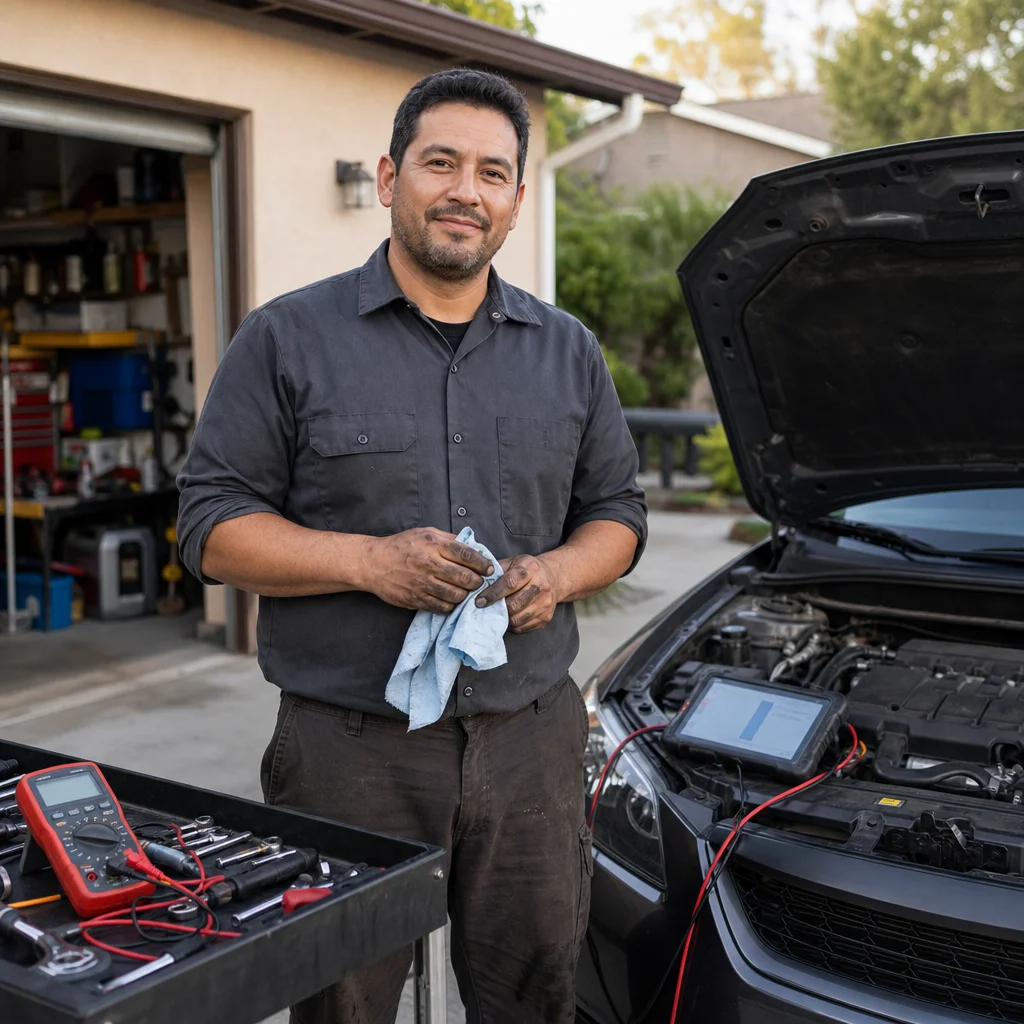
A car that sits for several weeks can have a flat battery even when nothing appears to be wrong. The alarm, keyless-entry system, computers, and other standby electronics continue using a small amount of power, while cold weather reduces the battery’s available capacity. The question is whether you need a battery maintainer, a different storage routine, or a battery diagnosis.
For many infrequently used cars, a smart battery maintainer is the safest and simplest way to keep a healthy battery charged. It isn’t necessary for every vehicle, though. Your decision depends on how long the car sits, the battery’s age and condition, the temperature, and whether the vehicle has an unusual electrical drain.
What a battery maintainer actually does
A battery maintainer is a low-current charger designed to monitor battery voltage and adjust or stop its output as the battery reaches full charge. Unlike a basic charger that keeps delivering current, a proper smart maintainer can switch to a maintenance or float mode and periodically check whether the battery needs more energy.
That distinction matters. A battery that remains connected to an unsuitable constant-output charger can be overcharged, lose water if it is a conventional flooded lead-acid type, or suffer unnecessary damage. The word “trickle” doesn’t always tell you how a product behaves; some trickle chargers are regulated, while others are simply low-output chargers. Read the product specifications rather than relying on the name.
A maintainer also doesn’t repair a weak battery or compensate indefinitely for a serious parasitic drain. If the battery goes flat despite being connected to a correctly sized smart maintainer, the battery, charger, vehicle wiring, or connection deserves investigation.
When a maintainer is usually worthwhile
A maintainer is particularly useful when a vehicle will sit for a month or longer, when it is used only occasionally, or when it has a seasonal role such as a convertible, classic car, motorcycle-derived project, or second vehicle. It can also make sense for a modern car parked for several weeks in cold weather, because standby electronics continue drawing power and low temperatures make starting more demanding.
The battery’s condition is just as important as the storage period. A healthy, fully charged battery may cope with a few weeks of inactivity in moderate weather. An older battery with reduced capacity may not. If the battery is already several years old, has needed repeated jump-starts, or cranks slowly after short periods of sitting, a maintainer may only delay replacement.
A maintainer is less useful if the car is stored where connecting to household power is impractical, if the battery has a fault, or if the vehicle’s electrical system is drawing far more current than normal. In those cases, identify the underlying problem rather than treating the maintainer as a permanent workaround.
Confirm the charging setup: Before connecting anything, check the charger’s instructions, the battery label, and the vehicle owner’s manual for compatible battery types, connection points, ventilation requirements, and any storage restrictions. Product designs and vehicle charging provisions vary, so current manufacturer guidance takes priority over general advice.
Maintainer, trickle charger, or occasional driving?
A smart maintainer is generally the best option for a car that will remain parked near a safe electrical outlet. It keeps the battery near full charge without requiring you to remember a charging schedule. Choose a unit intended for your battery’s voltage and chemistry, and use a model with basic protections such as reverse-polarity, short-circuit, and over-temperature protection.
A regulated trickle charger can work if its instructions specifically permit continuous connection. If it doesn't automatically reduce or stop charging when the battery is full, don’t leave it attached for weeks without supervision. A basic charger may be suitable for charging a depleted battery under observation, but that doesn't make it a suitable maintainer.
Occasional driving can help, but a short trip isn't a guaranteed substitute. Starting the engine uses a substantial amount of energy, and a brief drive may not return all of it—especially with headlights, a heated rear window, a blower, and other electrical loads operating. Idling on the driveway is usually a poor charging strategy and creates exhaust and ventilation hazards. If you drive the car, a reasonably long trip that allows the engine and charging system to operate normally is more useful than repeated short starts, but it still may not overcome a deteriorated battery or an abnormal electrical drain.
A solar maintainer can be a practical alternative where mains power is unavailable. Its output depends on panel size, shading, weather, orientation, and the vehicle’s storage location. Use a unit designed for battery maintenance, not an improvised panel connection, and confirm that its controller and connectors are appropriate for the battery.
Choosing the right battery mode
Most passenger cars use a 12-volt lead-acid battery. This may be a conventional flooded battery, an AGM battery, or an EFB battery. These types can have different charging requirements, so select the charger mode specified for the battery. AGM batteries commonly require a dedicated AGM setting, while an incorrect mode can result in unsuitable charging voltage.
Some vehicles use lithium-based starter batteries, although they are less common than lead-acid batteries in ordinary passenger cars. A lithium battery requires a charger specifically designed for its chemistry and battery-management system. Don’t assume that a charger marked “12 volt” is automatically compatible with every 12-volt battery.
Cold conditions reduce a battery’s effective starting capacity. A battery that seems acceptable in mild weather may struggle after several weeks in freezing temperatures. Cold also makes charging a deeply discharged battery more complicated. Never try to charge a visibly damaged, leaking, swollen, or frozen battery. Move the vehicle or battery to a suitable temperature-controlled location only if the manufacturer’s instructions allow it, and replace a battery that shows physical damage.
Connecting a maintainer safely
Start with the vehicle parked securely, the ignition and accessories switched off, and the charger unplugged or switched off. Inspect the battery and cables for damage or corrosion. Connect the positive lead to the positive terminal and the negative lead to the point specified by the charger or vehicle manufacturer. Some vehicles provide a designated under-hood charging or ground point, particularly when the battery is in the trunk or when the battery-monitoring system requires a particular connection.
Keep the charger and battery in a dry, ventilated location. Conventional lead-acid batteries can release hydrogen gas during charging, and sparks or flames near the battery can cause a fire or explosion. Don’t charge a battery in a living area, block the charger’s ventilation openings, or place it where water can reach the electrical connections. Route cables so they won’t be pinched by the hood, trunk lid, or a moving part.
Once the leads are connected correctly, plug in or switch on the charger according to its instructions. Confirm that it recognizes the battery and shows a normal charging or maintenance status. If it reports a fault, becomes unusually hot, smells strongly of sulfur, or behaves erratically, disconnect it safely and stop using it until the cause is understood. Switch the charger off or unplug it before removing the leads.
Permanent ring-terminal leads can make future connections easier, but they must be installed with the correct polarity and protected from short circuits. A quick-disconnect plug should be positioned where it can't contact a hot engine component, belt, fan, or wet surface.
Alternatives when you can’t use a maintainer
Disconnecting the negative battery cable can reduce the vehicle’s standby drain during storage. This may preserve charge, but it can also disable alarms, erase clock and radio settings, affect window or steering-system calibration, and create issues for vehicles that rely on continuous power. Some models also require a specific reconnection or relearning procedure. Check the vehicle manual before choosing this approach.
Removing the battery and storing it in a cool, dry, ventilated place can be reasonable for some seasonal vehicles, provided the manufacturer permits it and the battery is secured upright where appropriate. It still needs periodic charging, and a removed battery shouldn't be placed near children, flames, or damp conditions. If the vehicle has a battery-management sensor or complex electronics, professional or manufacturer guidance may be worthwhile.
If the vehicle sits outside, protecting it from weather won’t prevent battery drain by itself. A cover, tire-pressure check, and fuel-storage routine address other parts of long-term storage, but they don’t replace keeping the battery charged or disconnecting the relevant load.
Don’t overlook a parasitic drain
A healthy battery connected to a suitable maintainer shouldn't repeatedly go flat. If it does, check simple causes first: a trunk or glove-box light that stays on, an accessory plugged into a power socket, a dash camera, aftermarket audio equipment, or a door that isn’t fully latched. Some vehicles also take time to enter their normal sleep mode after being locked.
Repeated battery failure can point to an electrical fault, a charging-system problem, or a battery that no longer holds charge. A repair shop can measure the vehicle’s resting current after its modules go to sleep and test the battery and alternator. Avoid pulling random fuses or disconnecting safety-related systems without a wiring diagram and a clear plan.
A sensible storage decision
If your car is healthy, sits for only a week or two, and is stored in moderate weather, you may not need a maintainer. A fully charged battery and an occasional proper drive may be enough, although a maintainer remains more predictable than starting the car briefly just to keep it alive.
For storage lasting several weeks or more—especially in cold weather—a compatible smart maintainer is usually the most reliable choice when safe power is available. Match it to the battery chemistry, follow the vehicle’s connection points, and keep the setup dry and ventilated. If the battery still loses charge, treat that as a diagnostic clue rather than simply buying a more powerful charger. A sound battery and a sound charging system should make storage routine, not a cycle of jump-starts.