How to Diagnose a Check-Engine Light That Appears Only in Rain
You can either replace parts based on a generic fault code or first trace what rain is changing under the hood. I’ll show you how to record the conditions, inspect moisture-sensitive ignition and electrical points, and spend diagnostic money only where it helps.
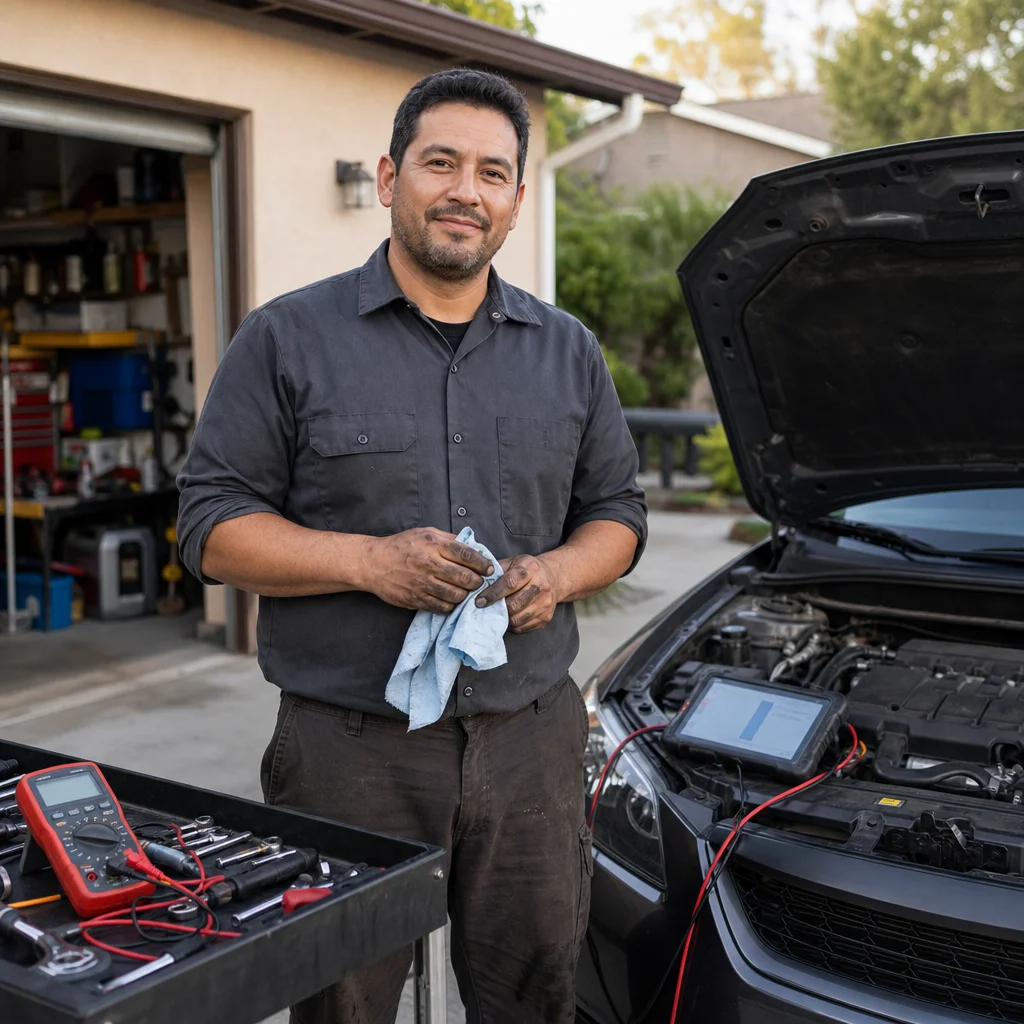
A check-engine light that appears only during rain is giving you a useful clue, but not necessarily a complete diagnosis. Water may be affecting ignition, a connector, a ground, an intake system, or wiring that is already marginal. The goal is to identify what changes when the weather turns wet before you clear the code or start replacing parts.
Because this problem is intermittent, your notes and scan-tool data matter as much as the visual inspection. A fault that disappears when the engine dries out can be difficult to reproduce in a driveway, so record the conditions carefully and follow the evidence in stages.
Start by recording exactly what happens
Note whether the light appears while driving through heavy rain, shortly after starting, during a car wash, or after the vehicle has been parked outside overnight. Also record engine temperature, vehicle speed, engine load, outside temperature if available, and whether the engine hesitates, shakes, stalls, or loses power.
Pay attention to whether the light is steady or flashing. A steady light generally indicates that the vehicle has detected a fault that may not require immediate shutdown, although the underlying problem still needs attention. A flashing light can indicate an active misfire severe enough to damage the catalytic converter. Reduce load and stop driving when it is safe; if the engine is running very poorly, have the vehicle inspected rather than continuing to test it on the road.
Use a scan tool before clearing anything. Read stored and pending diagnostic trouble codes, and save freeze-frame data if your scanner supports it. Freeze-frame information may show engine speed, coolant temperature, throttle position, and other conditions when the fault was recorded. A code such as a cylinder-specific misfire is more useful than a general statement that the check-engine light came on, but neither type identifies the failed part by itself.
Record the wet-weather trigger: Before clearing codes, write down what the rain was doing, when the light appeared, how the engine behaved, and whether the light went away after drying. Those details can prevent you from losing the pattern that makes the fault diagnosable.
Interpret the code as a direction, not a verdict
A code for a misfire, oxygen-sensor signal, lean condition, or communication fault describes what the control module observed. It doesn't automatically prove that the named sensor or component needs replacement. Rain can create a symptom in one area and produce a code in another.
For example, moisture around an ignition coil or spark-plug well may cause a misfire. The engine computer can then report a cylinder misfire, an ignition-related code, or, under some conditions, a fuel-trim code. An intake leak may create a lean condition, while a wet connector or poor ground may produce an implausible sensor reading. Check the service information for the exact code and vehicle before deciding which tests apply.
Pending codes are especially valuable in this situation. They may show that the computer has noticed a developing problem even when the light hasn't stayed on long enough to set a confirmed code. If you erase the codes immediately, you may also erase useful freeze-frame and readiness information.
Inspect ignition components first when the engine misfires
Rain-related misfires often deserve an early inspection because ignition components are exposed to heat, vibration, and moisture. With the engine off and cool, inspect the ignition coils, coil boots, spark-plug wells, plug wires if the engine uses them, and nearby covers or seals. Look for water tracks, white or green corrosion, dark carbon lines on a boot, cracked insulation, oil in a plug well, or a missing rubber seal.
A small amount of moisture in the wrong place can allow voltage to leak away instead of jumping the spark-plug gap. A damaged coil boot or worn plug can behave normally in dry weather and fail when humidity rises. If the misfire code identifies one cylinder, compare that cylinder's coil or plug with another cylinder only when the design and service procedure make that swap appropriate. If the misfire moves with the component, you have stronger evidence that the component is involved. If it stays in the same cylinder, investigate the plug, injector, compression, wiring, and mechanical condition instead.
Don't spray water onto a running engine as a casual test. That can create an electrical hazard, make a bad connection worse, or expose you to moving belts and fans. If a controlled moisture test is appropriate for your vehicle, use the manufacturer’s service procedure or let a qualified technician perform it.
Check before touching ignition parts: Keep the engine off when inspecting coils, plug wires, and connectors, and follow the vehicle service information for any high-voltage ignition precautions. Never pull a coil or wire from a running engine to look for a change.
Look for wet connectors, damaged seals, and harness problems
Inspect connectors near the ignition system, air-intake plumbing, mass-airflow sensor, throttle body, oxygen sensors, and engine-control components. You are looking for loose locks, broken backshells, missing weather seals, water droplets, dirt packed into the seal, and green or white corrosion on terminals. A connector can look attached while its terminal tension is too weak to maintain a reliable connection.
Trace the wiring a short distance away from each connector. Harnesses can rub against brackets, become brittle from heat, or collect water where a section sags. Pay particular attention to areas under the hood that receive spray from a wheel well or sit below the edge of the hood. If rain reaches a damaged section, the fault may occur only while the vehicle is moving.
Don't fill connectors with general-purpose grease or force probes into sealed terminals. Use electrical contact cleaner only when it is compatible with the connector and the vehicle’s service instructions. A connector that is corroded, loose, or missing a seal may need terminal repair rather than simple cleaning.
Check grounds and power connections
A weak ground can cause several unrelated-looking symptoms when moisture changes the resistance of a connection. Inspect the battery terminals, engine-to-body ground strap, body grounds, and visible ground points for looseness, corrosion, broken strands, or paint and rust between the terminal and mounting surface.
A visual inspection can't prove that a ground is good. A voltage-drop test while the relevant circuit is operating is more useful. Your vehicle’s wiring diagram can show which ground serves the affected sensor, ignition component, or control module. If you’re not comfortable reading the diagram or testing a live circuit, paying for a focused electrical diagnosis is usually cheaper than replacing several sensors.
Also check battery voltage and charging-system behavior if the vehicle has multiple warning lights, difficult starting, or intermittent electrical glitches. Low system voltage can complicate scan results, although it doesn't explain every rain-related fault. Correct a power or ground problem before chasing secondary codes.
Examine the intake for moisture and unmetered air
Rain can expose an intake leak that is already present, especially around the air-filter housing, intake boot, resonator, mass-airflow sensor, and vacuum hoses. Look for a loose clamp, split rubber, a distorted seal, a missing air-box fastener, or water collected in the air-filter housing. If the air filter is damp or visibly damaged, find out how water entered before installing a new filter.
An intake leak usually allows air into the engine that the computer didn't measure. Depending on where the leak is and how the system is designed, this can produce a lean code, unstable idle, hesitation, or misfire. A wet-weather connection may be the actual cause, but a cracked intake boot can also become more noticeable when temperature and humidity change.
Avoid using flammable sprays to search for vacuum leaks. A smoke test is safer and more informative when the leak is difficult to see, but it should be performed with equipment and procedures suitable for the vehicle. Don't assume that a lean code means the oxygen sensor is defective.
Use a repeatable test instead of guessing
After the initial inspection, make one change at a time. Dry and repair a verified connector, replace a damaged seal, tighten a loose ground, or correct an intake defect, then scan again and monitor the same operating conditions. Replacing several parts at once may make the light disappear, but it leaves you uncertain about the cause and can waste money.
If the fault isn't active, use the scanner to observe live data while the engine warms up and during a road test that can be performed safely. Look for misfire counters, fuel trims, sensor signals, and system voltage when the symptom occurs. The exact interpretation depends on the engine and scan tool; a sudden change in one value is more meaningful when it happens at the same time as the misfire or warning light.
Don't clear the code repeatedly just to see whether it returns. Clearing codes resets diagnostic information and may reset emissions readiness monitors. If you need to clear a code after a repair, confirm that the repair is complete, save the original data first, and understand that the vehicle may need several normal drive cycles before all monitors run again.
Know when the efficient choice is professional diagnosis
A professional inspection becomes the cost-efficient option when the light flashes, the engine stalls, the fault affects braking or steering systems, wiring is damaged, or the problem involves a vehicle-specific network or control module. It is also sensible when the code returns after basic connector, ignition, intake, and ground checks.
Bring your notes and scan results rather than simply reporting that the car “doesn’t like rain.” Tell the technician whether the vehicle was wet from rain or a wash, whether it was cold or warm, what speed and load were present, and how long the light stayed on. Reproducing the conditions may require a water-intrusion inspection, circuit testing, smoke testing, or a controlled road test.
A rain-only check-engine light is best approached as a moisture-triggered event, not as an automatic request for a new sensor. Save the codes, inspect the places where water can reach ignition and electrical connections, check intake seals and grounds, and make repairs one at a time. If the warning is flashing or the engine is running badly, stop treating it as a driveway experiment and arrange a proper diagnosis.